Measurement
Is my Meta traffic campaign to Walmart or Amazon a waste of money?
One nursery furniture brand spent $83,602 on Meta traffic ads to Walmart, Amazon and Target, and Meta counted 0 sales, because those purchases happen on the retailers' sites and in their stores. We can't say for sure it was wasted, but there are indicators the clicks are weak.
Where did this brand's Meta traffic money go?
To the brand's products at retailers, almost all of it at Walmart. From 30 April to 29 October 2026 the account spent $460,463, and $83,602 of it, 18.2%, went to five traffic campaigns optimized for link clicks.
The brand is a US nursery furniture brand with its own online store that also sells through big retailers. One campaign took $79,608 and sent people to the brand's products at Walmart, and some of its ads also pointed shoppers to stores. The other four were short sale pushes that shared the remaining $3,994 ($83,602 minus $79,608), about $1,000 each: two more to Walmart, one to Amazon and one to Target.
A link click is a click on the ad's link to its destination, and CPM is the price of a thousand impressions. Audience Network is the apps and sites outside Facebook and Instagram that show Meta's ads. An ad set is the part of a campaign that sets its audience, placements and goal, and frequency is how many times, on average, each person reached saw the ad.
| Link-click traffic, 30 April to 29 October 2026 | Value |
|---|---|
| Campaigns | 5 |
| Spend | $83,602 |
| Share of the account's spend | 18.2% |
| Cost per link click | $0.33 |
| CPM | $4.43 |
| Largest campaign: spend | $79,608 |
| Largest campaign: share of its spend on Audience Network | 12.9% |
| Largest campaign: highest ad set frequency | 8.2 |
| Optimized for | Link clicks |
| Purchases Meta counted | 0 |
Why does Meta show zero sales from ads that send people to Walmart or Amazon?
Because the purchase happens at the retailer, where the brand's pixel can't see it. The pixel is the code on a website that reports visits and purchases back to Meta, and these campaigns have no purchase tracking, so Meta counts no sales from them, whatever they bring.
The brand still benefits when a shopper buys its products at Walmart, Amazon or Target. That order just never reaches the brand's Meta account, and an order placed in a store never reaches any website at all. So the zero in Ads Manager says nothing either way about whether the ads sold anything.
It also means this spend can't be judged next to the rest of the account. The sales campaigns made a ROAS of 13.24 on Meta's count over the same six months. ROAS, or return on ad spend, is the sales Meta credits to the ads divided by what the ads cost. The traffic campaigns show a ROAS of 0, which is a gap in the measurement. The audit rates the spend a critical finding: 18.2% of the spend on the cheapest clicks, with no sale Meta can see.
If the orders Meta credits look wrong even on your own store, we covered how to check them in why Meta's purchases don't match Shopify.
Was the $83,602 wasted?
We can't say for sure, but there are indicators the clicks are weak. The audit's own verdict is that "nobody can say from this account whether that money paid", and the account shows four signs of cheap clicks.
- Price. A link click cost $0.33 across the traffic campaigns and $0.34 on the largest one. Impressions cost $4.43 per thousand, against $9.36 on the sales campaigns.
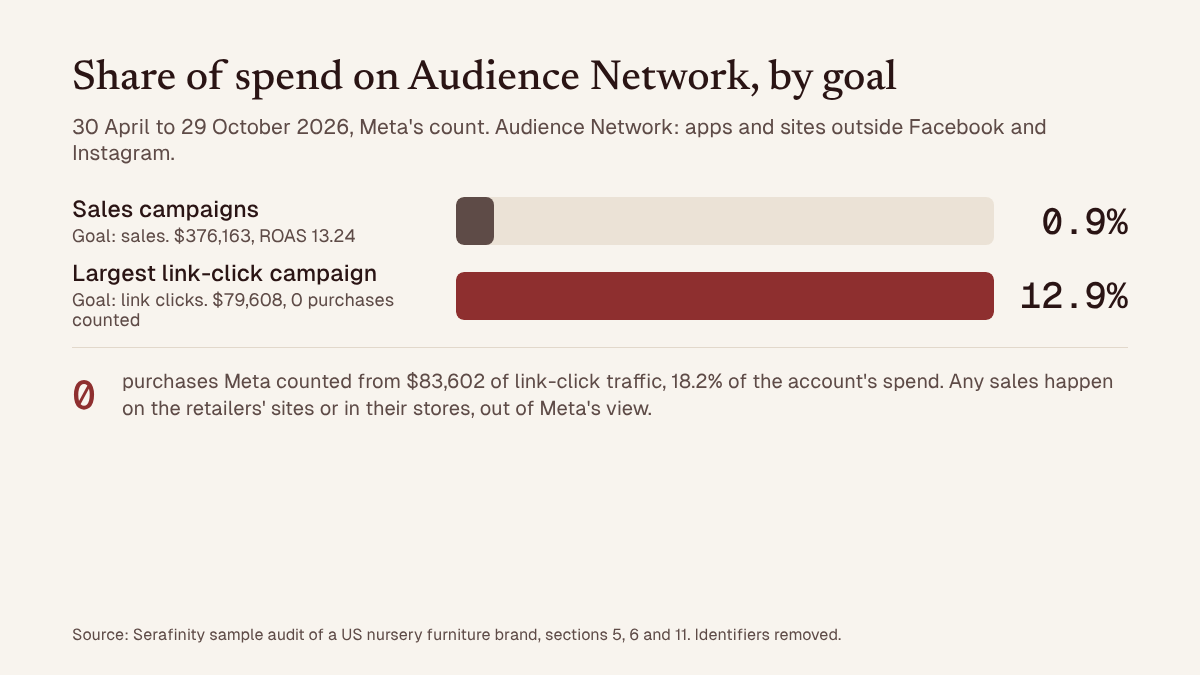
- Audience Network. 19% of the largest campaign's clicks came from Audience Network, and it took 12.9% of that campaign's spend, against 0.9% on the sales campaigns.
- Repetition. One ad set, named for Audience Network, spent $11,025 at a frequency of 8.2, so the same people saw the ad about eight times each.
- Page views. Meta recorded a landing page view, its count of clicks that went on to load the page, for 26% of the largest campaign's clicks, against 35.4% on the sales campaigns. Treat that count as rough. The brand's pixel isn't on the retailer's page, Meta says "statistical modeling may be used to account for some landing page views" (Meta, About landing page view optimization), and the audit found page views look under-counted even on the brand's own store.
None of this proves the clicks sold nothing. It shows what the money bought: a lot of cheap clicks, and few page views that Meta could record.
What is the difference between traffic clicks and conversion-optimized clicks?
The goal you set decides who Meta shows the ad to. Meta's help center says a link-click goal shows your ads to "people most likely to click on them", and a conversion goal to "people most likely to take a specific action on your website" (Meta, About performance goals).
A conversion goal learns from purchases, so it looks for buyers. A link-click goal counts a tap as success whether or not anyone buys. The same account shows the gap.
| Same six months | Link-click traffic | Sales campaigns |
|---|---|---|
| Objective | Traffic (goal: link clicks) | Sales |
| Spend | $83,602 | $376,163 |
| CPM | $4.43 | $9.36 |
| Cost per link click | $0.33 | about $0.99 (worked out) |
| Share of spend on Audience Network | 12.9% (largest campaign) | 0.9% |
| ROAS, Meta's count | 0 (no purchase tracking) | 13.24 |
The sales campaigns' cost per link click is our arithmetic, since the audit doesn't print it: $9.36 buys 1,000 impressions, and at their link CTR of 0.95%, the share of impressions that got a link click, those bring 9.5 link clicks, about $0.99 each.
Where Meta learned from purchases, Audience Network took 0.9% of the spend. On the largest link-click campaign it took 12.9%. That fits a goal that rewards any click, though one of its ad sets was named for Audience Network, so part of the share may come from how it was set up.
Switching these campaigns to a sales goal doesn't fix it on its own. A sales goal needs a purchase it can see, and the purchase happens at the retailer.
What should you optimize for when the sale happens on a retailer's site?
Landing page views, with Audience Network off, while a holdout measures the sales. For traffic to a website's pages, Meta recommends landing page view optimization over link clicks, "since the former can improve traffic quality", and calls it "a good choice if you don't have lower-funnel events (such as purchase conversions) set up yet" (Meta, Best practices for landing page view optimization).
The audit's plan makes these changes in week 1, 2 to 8 November:
- Turn Audience Network off.
- Switch the goal from link clicks to landing page views. Meta already records page views on these ads, so it can look for people who wait for the page to load.
- Tag the links with tracking parameters, so each visit carries the ad it came from.
- Split the ad set that reached a frequency of 8.2, and refresh its ads.
Expect the account's click-through rate and cost per click to look worse for a while. The audit flags it as a short-term effect: the cheapest clicks are the ones that go.
How do you measure Meta ad sales on Walmart or Amazon?
Your own pixel can't see them, because the checkout belongs to the retailer, so you need the retailer's data or a test. Three tools help, and only the last one compares sales with and without the ads.
- Amazon Attribution, for Amazon. Amazon calls it "a free measurement solution", open to "professional sellers enrolled in Amazon Brand Registry, vendors, KDP authors, and agencies", and it covers social channels such as Meta (Amazon Ads, Amazon Attribution). You add its tag to the ad's link, and Amazon reports what the tagged clicks led to on Amazon.
- Collaborative Ads, where the retailer takes part. The retailer shares part of its product catalog with the brand, and the brand can run catalog ads, which show products from that catalog, with the sales objective. Meta says these ads are "designed to help drive sales on a retailer's website or app", and that Ads Manager shows "aggregated conversion metrics", such as purchases of the shared items (Meta, About collaborative ads). To find retailers that take part, Meta points to its retailer directory or your Meta sales team.
- A geo holdout, for any retailer and for store sales. The plan keeps the traffic ads out of a matched 25% of the audience, chosen by region, for 4 weeks from 9 November, keeps them running everywhere else, and reads the difference in week 6, 7 to 13 December.
Neither Amazon Attribution nor Collaborative Ads is part of the audit's plan. A holdout is a group kept from seeing the ads, so its results show what happens without them; in a geo holdout the group is a set of regions. Meta can't supply those sales, so the test reads sales by region from the brand's own data, and the plan asks for access to it in week 1.
The traffic runs on its own budget, kept out of the sales budget and every ROAS figure in the plan. Once the holdout is read, the budget stays only where the extra sales it shows cover what the ads cost. The same plan raises the sales campaigns' budget in steps, as we covered in how much to raise a Meta budget for Black Friday.
How do you check your own Meta traffic campaigns?
Find every campaign that pays for clicks, see where its links go, then decide what each one needs before you judge it.
- In Ads Manager, list every campaign with the traffic objective and check each ad set's performance goal.
- Open each ad and note where its link goes: your own store, a retailer or a marketplace.
- For links to a retailer, read a ROAS of 0 as unmeasured. Meta can't see that checkout.
- Break the largest campaign down by placement. Note Audience Network's share of spend and clicks, and compare link clicks with landing page views, keeping in mind that page views on a retailer's site are a rough count.
- Check frequency by ad set, and refresh or split any ad set where the same people keep seeing the same ad.
- Move the goal to landing page views, turn Audience Network off and tag the links.
- Before you raise or cut the budget, keep the ads out of a matched set of regions for 4 weeks and compare sales there with the rest.
What else do people ask about Meta ads that send traffic to retailers?
Three related questions come up often.
Should I turn off a Meta traffic campaign that shows no sales?
Not before you have measured it, if it sends people somewhere Meta can't see. The audit's advice for this spend is to keep it running and make it measurable, then keep the budget only where the extra sales cover the cost.
Should I send Meta traffic straight to Amazon, or to my own site first?
Sending the click to a page on your own site first is common advice, and it lets your pixel see the visit before the shopper moves on to the retailer. That gives Meta a page view to learn from, but the sale still happens where Meta can't see it, so a holdout is still what tells you whether the ads pay.
Why are Meta traffic clicks so cheap?
Because a link-click goal shows the ads to the people most likely to click, and in this account Meta went for the cheapest clicks it could find: 19% of the largest campaign's clicks came from Audience Network. A link click cost $0.33 on the traffic campaigns and about $0.99 on the sales campaigns.
About this data
The figures come from a Serafinity sample audit of a US nursery furniture brand, published with client identifiers removed. Names, prices, ad wording, rival names and the brand's own terms are withheld or generalized. Account figures and dates are exact.
The audit covers $460,463 of Meta spend from 30 April to 29 October 2026, against the same months of 2025 and 2024. The traffic figures are from sections 5 and 11. "Sales campaigns" means every campaign whose objective is sales, with link-click traffic and boosted posts left out; their cost per link click is worked out from their CPM and link CTR in section 6. Which retailers the traffic went to, and what the four smaller campaigns were for, come from the ad account itself; the sample audit doesn't name them. Every ROAS is on Meta's count. Meta's and Amazon's pages quoted here were checked on 6 November 2026.
You can read the full nursery furniture sample audit (PDF), sections 3, 4, 5, 6, 11, 19 and 23, or see what an audit of your own account costs. Serafinity audits accounts and does not run them, so nothing here is a pitch for management.
Sources
- Serafinity, Meta Advertising Audit and 90-Day Scale Plan, nursery furniture sample, pages 2, 6, 7, 8, 9, 15, 23, 24, 37 and 40.
- Meta Business Help Center, About performance goals, checked 6 November 2026.
- Meta Business Help Center, Best practices for landing page view optimization, checked 6 November 2026.
- Meta Business Help Center, About landing page view optimization, checked 6 November 2026.
- Meta Business Help Center, About collaborative ads, checked 6 November 2026.
- Amazon Ads, Amazon Attribution, checked 6 November 2026.
More answers
Should I increase my Meta ads budget for Black Friday 2026?
In a real audit, Black Friday week to Cyber Monday made a ROAS of 12.27 on 28% more spend a day than the four weeks before. How to set your 2026 Meta budget.
INSIDE THE ACCOUNT S1E1: Why did my giveaway lower my account ROAS?
A giveaway took account ROAS from 4.64 to 3.55: small orders, buyers moved from other campaigns, and $5,193 spent at 1.45 after the bonus ended.
Why did my ROAS drop when I increased my Meta ads budget?
In one audit, spend over $5,000 a day returned 1.26, then 1.02, against a 1.39 break-even. Why ROAS drops as you increase a Meta budget: diminishing returns.