Scaling
Should I increase my Meta ads budget for Black Friday 2026?
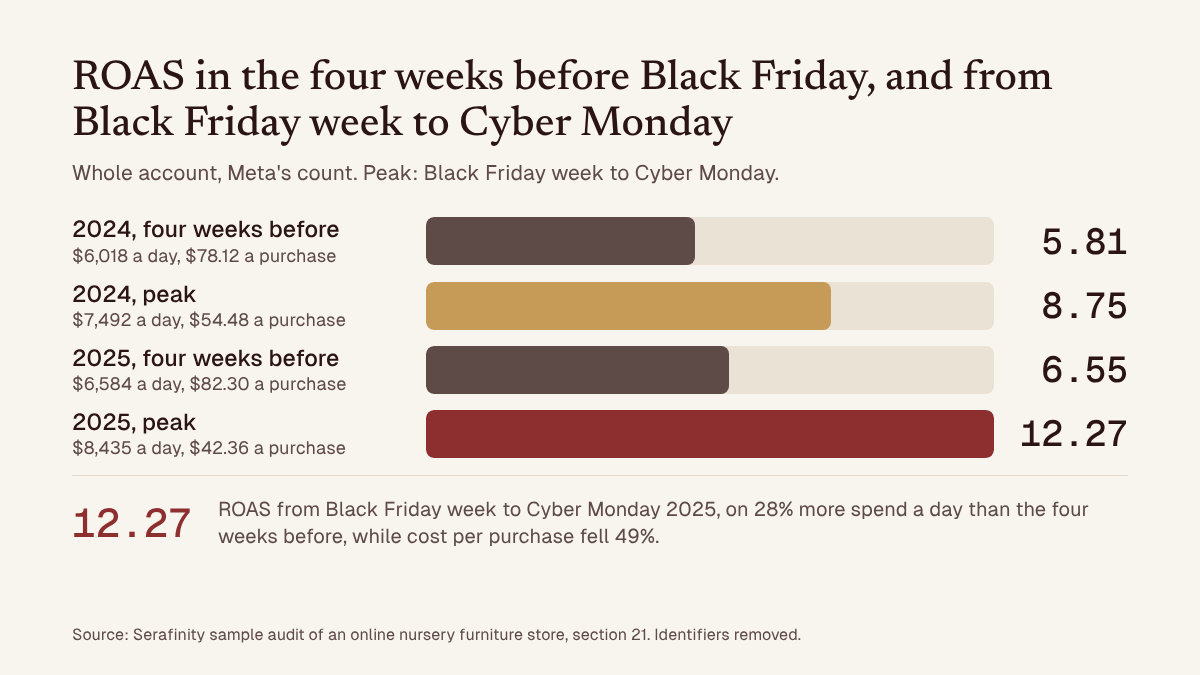
Raise it if your last two Black Fridays paid, and only as high as the same campaigns have gone. In one real audit of a nursery furniture store, Black Friday week to Cyber Monday made a ROAS of 8.75 in 2024 and 12.27 in 2025, against 5.81 and 6.55 in the four weeks before.
What did one store's last two Black Fridays return?
Both paid better than the weeks before them. Black Friday week to Cyber Monday made a ROAS of 8.75 in 2024 and 12.27 in 2025, against 5.81 and 6.55 in the four weeks before, while spending more a day.
ROAS, or return on ad spend, is the sales Meta credits to the ads divided by what the ads cost. Cost per purchase is ad spend divided by the purchases Meta credits. The store is an online nursery furniture store advertising in the US, with an average order of $604.21.
| Period | Spend a day | ROAS | Cost per purchase |
|---|---|---|---|
| 2024, four weeks before | $6,018 | 5.81 | $78.12 |
| 2024, Black Friday week to Cyber Monday | $7,492 | 8.75 | $54.48 |
| 2025, four weeks before | $6,584 | 6.55 | $82.30 |
| 2025, Black Friday week to Cyber Monday | $8,435 | 12.27 | $42.36 |
These are whole-account figures on Meta's count. In 2024, Black Friday week to Cyber Monday spent 24% more a day than the four weeks before, and cost per purchase fell 30%. In 2025 it spent 28% more, and cost per purchase fell 49%. November and December took 24% of the year's spend in both years.
Why did this store's Black Friday ads pay better than the weeks before?
Because its buyers converted far better. In 2025 a purchase cost $42.36 from Black Friday week to Cyber Monday, against $82.30 in the four weeks before, while each day's spend rose 28%.
The audit gives only spend, ROAS and cost per purchase for the two Black Friday weeks. Its daily data shows how higher-spend days behaved: it grouped the 183 days from 30 April to 29 October 2026 by how much the sales campaigns spent. On the lowest-spend days a click cost $0.94 and 1.87% of clicks became a purchase. On the highest-spend days a click cost $1.08 and 2.52% became a purchase. So a purchase cost $50.27 on the lowest-spend days and $42.86 on the highest ($0.94 divided by 1.87%, and $1.08 divided by 2.52%).
Sale days explain part of it. Of the 35 days in the top spend band, 16 fell in the window's three holiday sales, when the budget went up because a sale was on. Leaving the 19 sale days out, sales still rose faster than spend, and comparing days within the same month gave the same answer. The audit still calls for a controlled test, because the high-spend days were not chosen at random, and the plan starts one on 21 December.
Published benchmarks show the market around it. Lebesgue reports peak-week Meta CPM, the price of a thousand impressions, 51% above September (Lebesgue BFCM benchmark). Across the more than 33,000 shops in Triple Whale's data, Meta's ROAS over Black Friday to Cyber Monday 2025 was 2.26 (Triple Whale on Black Friday Meta ads). Neither shows one account's Black Friday against its own weeks before, which is the comparison that decides your budget.
How much should you increase your Meta budget for Black Friday?
In this plan, to 4.2 times today's daily budget for the four peak days, held close to the highest day the sales campaigns have reached. Triple Whale's guide calls spending 2 to 5 times the normal daily budget over the sale a common approach, and this plan lands inside that range for reasons of its own.
The sales campaigns spend $1,284 a day now, well below the window's average of $2,056. For the four peak days, 27 to 30 November, the plan runs them at $5,400 a day, then returns to the step reached.
| Sales campaign | Last 28 days, a day | ROAS, last 28 days | 27 to 30 November, a day |
|---|---|---|---|
| Advantage+ catalog ads | $241 | 8.4 | $2,570 |
| Advantage+ video | $646 | 4.4 | $1,285 |
| Bundle carousels, restarted with new ads | $0 | none | $771 |
| Older static campaign | $111 | 53.2 | $514 |
| Static and carousel testing, budget fixed | $285 | 3.2 | $260 |
| Total | $1,284 | 9.1 | $5,400 |
Why $5,400, when Black Friday week to Cyber Monday spent $7,492 and $8,435 a day in the last two years? Those were whole-account figures, while the plan covers the sales campaigns only. And $5,400 sits close to $5,485, the highest day the sales campaigns reached between April and October. The audit's fitted curve explains 67% of the day-to-day variation, but it describes only the range the window covered, so the plan doesn't extend it past that day.
One caution applies to all of these figures. Every ROAS here is on Meta's count, which in October 2026 credited the ads with 12.3% of the store's orders and includes sales after a view or an engaged video view. More spend buys more views, so part of a rise in ROAS at high spend may be counting.
When should you raise the budget before Black Friday?
In this plan, on 16 November, eleven days before Black Friday, so the step's week can be read before the sale starts. Week 2 holds still first, to set a baseline.
Step 1 lifts the sales campaigns from $1,300 to $1,600 a day, 23% more. It adds $2,100 over its week, and it passes only if the stepped campaigns' credited sales that week beat the week before by at least $16,467. That is a ROAS of 7.84 on the extra money, one and a half times break-even. The margin covers sales Meta credits that the ads didn't cause, and the noise in a single week's read. The step also waits for the click-ID fix described below.
From 23 November the ladder stops, because sale days and the Christmas cut-off make the extra spend unreadable. Week 4 averages $3,229 a day, with the four peak days from 27 November at $5,400. After Cyber Monday, spend goes back to the step reached. Every week from 23 November to 3 January has to stay at or above break-even, a ROAS of 5.23 on Meta's count.
Judge a step on the sales its extra money brought in, because the account's average ROAS still carries the old budget's sales, as we showed in why ROAS drops when you increase your Meta ads budget.
What has to be fixed before you spend more?
In this account, the catalog, the click ID and one Meta setting, most of it in week 1 and all of it in the plan's first three weeks.
- Stock. Catalog ads took 21.5% of the window's spend at a ROAS of 15.82, the best of the large campaign types. When the audit was done, more than half the catalog's items were out of stock. Items out of stock can't appear in catalog ads, so they come out of every product set the ads use.
- Product IDs. Only 60.4% of product IDs in purchase events matched a catalog item, against 95.8% for adds to cart, so Meta can't learn which products sell.
- The click ID. The click ID is the short code Meta adds to a link when someone clicks an ad. Only 1.6% of purchase events carried it, against 8.0% of page views, so Meta misses buyers who came from an ad and every budget step reads low. Step 1 waits until purchases carry it at least as often as page views do.
- On-device measurement. Events Manager shows a notice: "On November 12, 2026, all eligible pixels will start measuring conversions on customer devices." The audit recommends opting out until its lift test is read, so every period is counted the same way.
If Meta's count of your orders looks low, we covered how to check it against your store in why Meta's purchases don't match Shopify.
Should you lead with a deeper discount or a bundle?
With a bundle, in this plan. It leads Black Friday with bundles and a non-price incentive, which keeps the price intact, and gives bundle carousels with new ads 15% of the stepped budget.
The orders the catalog ads are credited with already exceed a single item, so the plan tests multi-item bundles in the catalog ads, with bundle sets as their own product set. The average order of $604.21 leaves $115.58 before ads, a margin share of 19.1%, which is why break-even sits at a ROAS of 5.23. A deeper discount comes straight out of that $115.58 on every order it touches, including orders that would have come at the full price.
New ads go live in week 1, so the four peak days run on ads that have already been read, and peak creative is approved in week 3.
When should Christmas ads switch to gifting?
The day after the last ship date that still gets an order there for Christmas. Count the store's stated delivery time back from 24 December to set that date, show the order-by date in the ads and on the site from 1 December, and switch the ads to gifting once the date passes.
The warehouse's handling time is confirmed in week 1, and the last ground ship date falls in week 6, 7 to 13 December. After it, the ads offer a nursery delivered in the new year, or a gift card. The audit rates late Christmas orders a low-likelihood risk that costs refunds and reviews.
How do you check your own last two Black Fridays?
Compare each Black Friday week to Cyber Monday with the four weeks before it, on the same counting rule, before you set a peak budget.
- In Ads Manager, export spend, purchases and purchase value by day at account level for the last two Novembers and Decembers, plus the four weeks before each Black Friday.
- For each year, work out spend a day, ROAS and cost per purchase for the four weeks before and for Black Friday week to Cyber Monday.
- Check that the attribution setting, the rule for which sales Meta counts for an ad, was the same in both periods, or the comparison isn't like for like.
- Work out this year's break-even ROAS: one divided by the share of an average order left after product, delivery, payment and returns.
- If both years beat the weeks before and break-even, plan a higher peak budget, but no higher than the highest day the same campaigns have reached. If they didn't, hold the total and move the mix.
- Before the sale, take any budget step early enough to read it, and stop stepping a few days before Black Friday.
What else do people ask about Black Friday budgets?
The same audit answers three related questions.
Do Meta ads always cost more on Black Friday?
The price of impressions usually rises, but cost per purchase doesn't have to. In this account, cost per purchase fell from $82.30 in the four weeks before to $42.36 over Black Friday week to Cyber Monday 2025, and the audit reads the last two peaks as converting far better than the weeks before. The number that decides the budget is cost per purchase against break-even.
Should I change my campaigns during Black Friday week?
As little as possible, apart from the peak budget, which is set in advance. This plan takes no ladder step from 23 November to 3 January. Its testing campaign keeps a fixed budget, $260 a day at the peak, so new ads can enter it in any week while the stepped campaigns run on ads already read.
What should I do with my budget in January?
Climb again only through checks. The plan's next steps fall on 4, 11, 18 and 25 January, each taken only if the step before earned a ROAS of at least 7.84 on its extra spend. The last waits for a lift test that measures what the ads add on their own. CPMs fall and conversion slows after Christmas, so compare January with past Januaries.
About this data
The figures come from a Serafinity sample audit of an online nursery furniture store, published with client identifiers removed. Names, prices, ad wording, rival names and the store's own terms are withheld or generalized. Account figures and dates are exact.
The audit covers $460,463 of Meta spend from 30 April to 29 October 2026, against the same months of 2025 and 2024. The Black Friday figures are whole-account figures on Meta's count; the plan's budgets cover the sales campaigns only. Every ROAS is on Meta's count. In October 2026 that count credited the ads with 12.3% of the store's orders.
You can read the full nursery furniture sample audit (PDF), sections 1, 2, 7, 8, 12, 19, 20, 21 and 23, or see what an audit of your own account costs. Serafinity audits accounts and does not run them, so nothing here is a pitch for management.
Sources
- Serafinity, Meta Advertising Audit and 90-Day Scale Plan, nursery furniture sample, pages 1, 4, 5, 10, 11, 16, 23, 24, 25, 26, 27 and 37.
- Lebesgue, 2026 BFCM Ecommerce Benchmark Report, accessed 4 November 2026.
- Triple Whale, Black Friday Facebook Ads: Data, Strategies, and AI Automations for 2026, updated 18 August 2026.
More answers
INSIDE THE ACCOUNT S1E1: Why did my giveaway lower my account ROAS?
A giveaway took account ROAS from 4.64 to 3.55: small orders, buyers moved from other campaigns, and $5,193 spent at 1.45 after the bonus ended.
Why did my ROAS drop when I increased my Meta ads budget?
In one audit, spend over $5,000 a day returned 1.26, then 1.02, against a 1.39 break-even. Why ROAS drops as you increase a Meta budget: diminishing returns.
Why don't my Meta ads purchases match Shopify?
In a real audit, Meta credited the ads with 76% of the store's orders. Why Meta ads purchases don't match Shopify, and how to check yours in 10 minutes.