Budget and scaling
What to do after Black Friday: is your old Meta ads budget still right?
Only for parts of December. It isn't one market, so give each part its own budget: what you spent a day then × (the ROAS you got ÷ the ROAS you need). No data from last year? Start at your old budget on 2 December and rerun the sum every 7 days.
Is your old budget still right after Black Friday?
Only in parts of December. The peak budget was bought for four days of sale traffic, so it has to come down. But the budget you ran in October was set for October's auction and October's buyers. December has at least four markets in it: the days right after Cyber Monday, the gift weeks before your shipping cut-off, the days after the cut-off, and Christmas to mid-January. Each one carries a different budget.
Your old budget will be right in some of them and wrong in others. One calculation tells you which.
What happens to ROAS in each part of December?
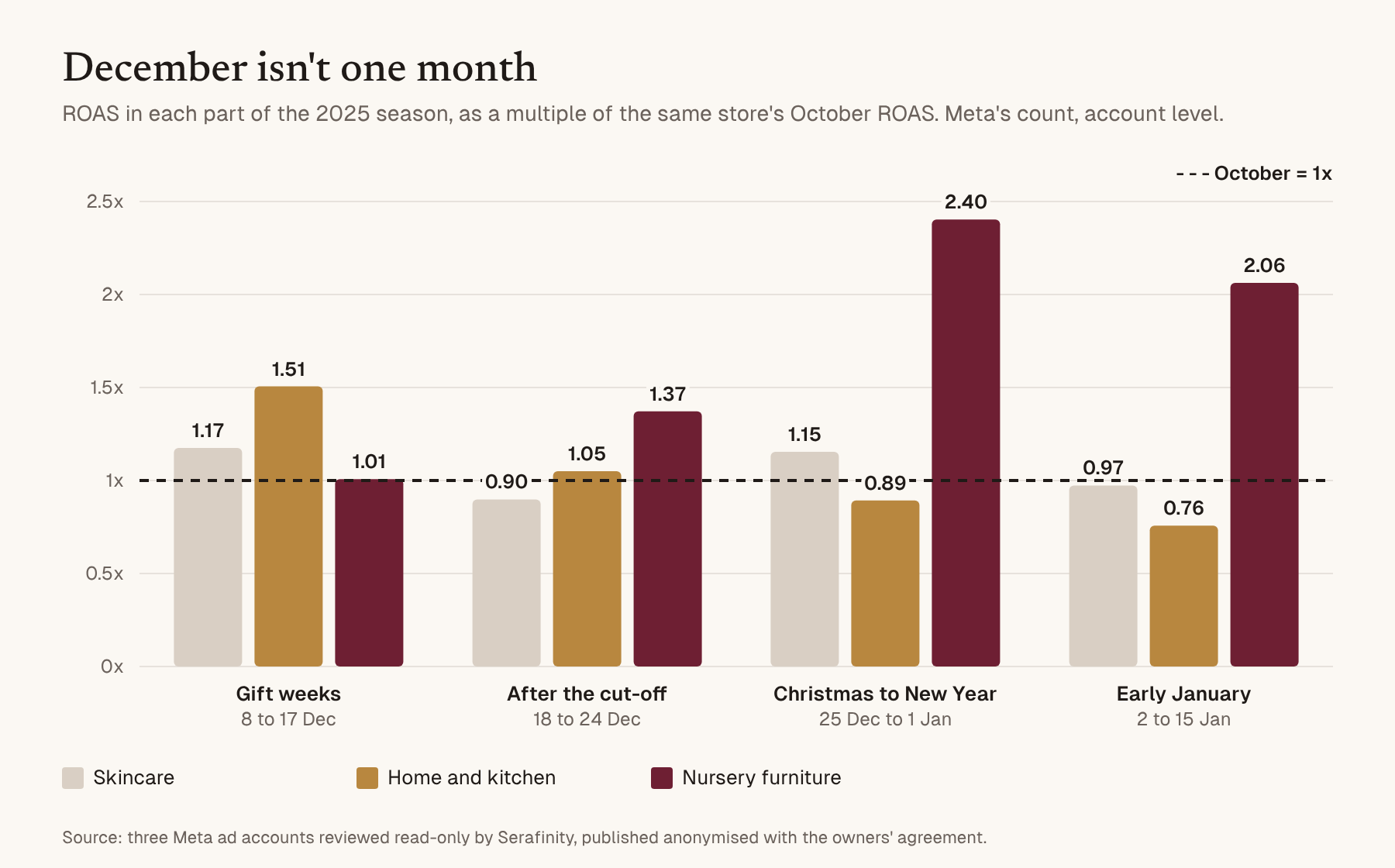
It moves a lot, and differently for each store. We split the 2025 season of three Meta ad accounts into parts and compared each with the same store's October:
| Part of the season | Skincare | Home and kitchen | Nursery furniture |
|---|---|---|---|
| Budget a day vs October, 8 to 17 Dec | 1.23x | 2.40x | 0.90x |
| ROAS vs October, gift weeks, 8 to 17 Dec | 1.17x | 1.51x | 1.01x |
| ROAS vs October, after the cut-off, 18 to 24 Dec | 0.90x | 1.05x | 1.37x |
| ROAS vs October, 25 Dec to 1 Jan | 1.15x | 0.89x | 2.40x |
| ROAS vs October, 2 to 15 Jan | 0.97x | 0.76x | 2.06x |
Three things stand out. The gift weeks matched or beat October in all three stores, even at 2.4 times the October budget. After the cut-off, the two gift-led stores lost 23% and 30% of their gift-week ROAS, while the nursery furniture store gained 36%. And from 25 December to 15 January, impressions cost 7% to 41% less than in October.
The wider auction shows the same breaks. Lebesgue's data across $22.6 million of Meta spend found that "Costs fell fast after Cyber Monday but were still 20% above baseline on December 3." Meta's guidance for app advertisers says the late-December weeks see less competition "as larger brands have left and shipping deadlines have passed."
How do you calculate your December budget?
Here's the calculation.
Think of December as four short months. For each one, look at what happened in the same part of last year and ask one question: was there room to spend more, or not?
Budget for that part = what you spent a day then × (the ROAS you got then ÷ the ROAS you need)
An example. Last year, in the gift weeks, you spent $500 a day and made a ROAS of 4, meaning $4 in sales for every $1 of ads. You need 3. So 500 × 4 ÷ 3 = $667 a day this year. After the cut-off you spent $500 a day and made 2.4. So 500 × 2.4 ÷ 3 = $400 a day.
The ROAS you need is your break-even ROAS × 1.3. Break-even is 1 divided by the share of an order you keep after product, shipping, fees and refunds: keep half and it's 2. Why add 1.3? ROAS is an average, and your last dollars always do worse than the average. So when the average sits at break-even, the last dollars are already losing money. In our insoles audit, profit a day peaked where the average ROAS was 1.81 against a break-even of 1.39: 1.3 times.
Two safety rules. Never set a part above 1.5 times what you spent in it last year, because past that you're guessing. And set all the budgets on 1 December and hold them; cut a part early only if a full week runs below break-even.
Would going back to the old budget have been right?
For some stores yes, for others not close. Using each store's October ROAS as the ROAS it needed, the calculation gives these budgets, as a multiple of the October budget:
| Part of the season | Skincare | Home and kitchen | Nursery furniture |
|---|---|---|---|
| Week after, 2 to 7 Dec | 1.58x | 3.12x | 1.18x |
| Gift weeks, 8 to 17 Dec | 1.44x | 3.60x | 0.91x |
| After the cut-off, 18 to 24 Dec | 1.14x | 2.82x | 1.02x |
| Christmas to New Year | 1.42x | 2.39x | 1.02x |
| 2 to 15 January | 1.21x | 1.55x | 0.97x |
For the nursery furniture store, going back to October's budget was within 18% of the sum in every part. For the skincare store it was too low in every part, and for the home and kitchen store far too low.
Our published insoles audit shows the other side. With its break-even of 1.39, the sum gives $2,465 a day for December 2025 against $2,452 before the sale, so going back was right. For December 2024 it gives $4,301 against $4,722: 9% less.
How do you calculate it with no data from last year?
Use this December's numbers, one week at a time:
- On 2 December, start at the budget you ran in the four weeks before the sale. It's the only budget you've tested. This is the one place going back is right: as a starting point, not a plan.
- Work out the ROAS you need: break-even × 1.3.
- Let the week run for 7 days, then wait 2 more. Meta keeps adding late sales to recent days, so a fresh week reads low.
- Run the sum on that week: next week's budget = this week's spend a day × (this week's ROAS ÷ the ROAS you need).
- Raise by no more than a fifth a week. Cut as far as the sum says. A week's ROAS can swing a lot on its own, so raises go slowly and losses stop fast.
- Start a fresh week on your cut-off day, on 25 December and on 2 January. Don't carry a gift-week read past your cut-off. If you sell gifts, cut by about a quarter on the cut-off day, then let the sum take over.
An example. From 2 to 8 December you spend $400 a day and make a ROAS of 3.6. You need 3. So 400 × 3.6 ÷ 3 = $480, exactly a fifth more. The next week makes 2.7: 480 × 2.7 ÷ 3 = $432.
If you get fewer than about 30 sales a week, read two weeks at a time. With so few sales, one good or bad day moves the ROAS too much to act on.
What if you don't ship anything?
The calculation stays the same. The calendar moves.
- Digital gifts (gift cards, subscriptions, courses, experiences) have no cut-off. You can sell gifts until Christmas Eve, in the very week shipping brands leave the auction.
- Subscriptions and apps: the season is January. Across US apps on Adapty, revenue peaked in the first week of January, 26% above a normal October week, though the median app gained only 5.8%. Install-to-paid was 39.4% in mid-January against 30.5% in October. Hold December and put the room into 26 December to mid-January.
- Software and services sold to businesses: buyers leave before Christmas. RevenueHero counted demo requests falling 24.4% in Thanksgiving week 2024. Treat 22 December to 2 January as its own part, and make sure someone answers the leads that come in.
If your ads count trials, demos or leads instead of purchases, there's no ROAS to use. Swap in cost per result:
Budget = what you spent a day then × (the cost per result you can afford ÷ the cost per result you got)
Say a paying customer leaves you $300 in their first year and 20% of trials pay. A trial is worth $60 to you, so you can afford $60 ÷ 1.3 = $46. Last December you paid $40 a trial at $200 a day: 200 × 46 ÷ 40 = $230 a day.
What should you do the week after Cyber Monday?
- On 1 December, turn off every ad with an expired offer. If the sale had its own campaign, turn off that campaign.
- Export last year's daily spend and purchase value from 27 November to 15 January, and mark your shipping cut-off.
- Run the calculation for each part and write the dates and budgets down before anything changes.
- No data? Start at your pre-sale budget and run the weekly version.
- Put your Christmas cut-off in the ads and on the site.
- Keep customers who just bought out of prospecting.
Questions owners ask next
Will changing the budget restart the learning phase?
It might, if the change is large. Meta lists the budget among changes that "may or may not be significant, depending on the magnitude of the change", with this example: "if you change your budget from $100 to $1000, one or more ad sets may reenter the learning phase." Meta's page gives no percentage. Change each budget in one move on its date and expect a few less stable days.
Should I turn my Meta ads off over Christmas?
Not without checking last year first. In the nursery furniture account, Christmas to New Year made 2.4 times October's ROAS. Meta also lists "Pausing your ad set for 7 days or longer" as a significant edit: the ad set "reenters the learning phase once you unpause" it.
What if my Black Friday sale lost money?
Then set December from your full-price break-even, not the sale's. In our insoles audit, Thanksgiving to Cyber Monday ran below break-even in both 2024 and 2025, at 1.37 and 1.25, while both Decembers ran above it, at 1.62 and 1.44.
About this post's evidence
The three stores are Meta ad accounts Serafinity reviewed read-only, published anonymised with their owners' agreement: a skincare brand, a home and kitchen brand and a nursery furniture brand. We pulled account-level spend, impressions, purchases and purchase value by day from 1 October 2025 to 31 January 2026 and checked the daily rows against Meta's totals for the whole window. Every ROAS is on Meta's count, at each account's own attribution setting. Phases are calendar dates, not each store's own cut-off. Each store's October ROAS stands in for the ROAS it needed, because we don't publish their break-evens. The insoles figures come from our published sample audit (section 18, page 27; break-even in section 8, page 14); applying its 2026 break-even to earlier seasons is our reading. The 1.3 comes from that audit's spend curve; the central reading in our designer streetwear audit gives about 1.16, so 1.3 is the more cautious of the two. The cut-off, Christmas and January dates for apps and B2B come from the sources below. Serafinity audits accounts and does not run them.
Sources
- Serafinity, sample audit, insoles: Meta Advertising Audit and 90-Day Scale Plan, sections 2, 8 and 18. https://serafinity.com/sample-audit-d2c-insoles.pdf
- Meta, "Significant edits and learning phase," Meta Business Help Center, checked 26 November 2026. https://www.facebook.com/business/help/316478108955072
- Lebesgue, "Are Meta Ads Worth It on Black Friday? CPM and ROAS Data," posted 16 October 2026. https://lebesgue.io/facebook-ads/are-meta-ads-worth-it-black-friday
- Social Media Today, "Meta Provides Tips for App Advertisers in Q5," 13 October 2025, quoting Meta. https://www.socialmediatoday.com/news/meta-provides-tips-app-advertisers-q5/802679/
- Adapty, "State of holidays for subscription apps 2026," checked 26 November 2026. https://adapty.io/blog/state-of-holidays-for-subscription-apps/
- RevenueHero, "Thanksgiving demo and lead form conversion trends," 25 November 2024. https://www.revenuehero.io/reports/thanksgiving-demo-lead-form-conversion-trends-nov-25-2024
Want this checked on your own account?
Serafinity audits Meta ad accounts read-only and never runs them. Your audit arrives in 2 to 5 working days, or in 24 hours if you need it sooner. See audit pricing.