Ad delivery
What does Learning limited mean on Meta ads?
Learning limited is an Ads Manager delivery status. It means Meta doesn't expect the ad set to get about 50 results in the week after its last significant edit, so Meta can't finish learning whom to show the ads to. It isn't a penalty, but Meta says ad sets below that line cost about 28% more per purchase.
What does Learning limited mean in Ads Manager?
It's the status Meta gives an ad set that it doesn't expect to finish learning: one that isn't on course for about 50 results in the week after its last significant edit. You see it in the Delivery column, next to Learning and Active.
When you create an ad set, or make a significant edit to one, Meta's delivery system goes through a learning phase. It tries different people and placements to work out who is most likely to take the action you chose, the optimization event. Meta says an ad set leaves this phase once it can deliver stably, which usually takes about 50 results in the week after its last significant edit.
| Delivery status | What it means |
|---|---|
| Learning | The ad set is new or has had a significant edit, and the delivery system is still exploring how to deliver it. Results are less stable and cost per result is usually higher. |
| Learning limited | The ad set isn't getting enough optimization events to leave learning, or isn't likely to: about 50 in the week after its last significant edit. |
| Active | The ad set has left the learning phase and delivers stably. |
Meta can mark an ad set learning limited at any point after you create or edit it. It moves to Active once it gets enough optimization events since its last significant edit. Shops ads have their own line: an ad set becomes learning limited if it hasn't had at least 17 purchases through your website and 5 through Meta after 7 days.
Why do my Meta ads say Learning limited?
Because the ad set can't get enough results in a week. Meta names six usual reasons:
- A small audience. Fewer people means fewer chances for someone to buy.
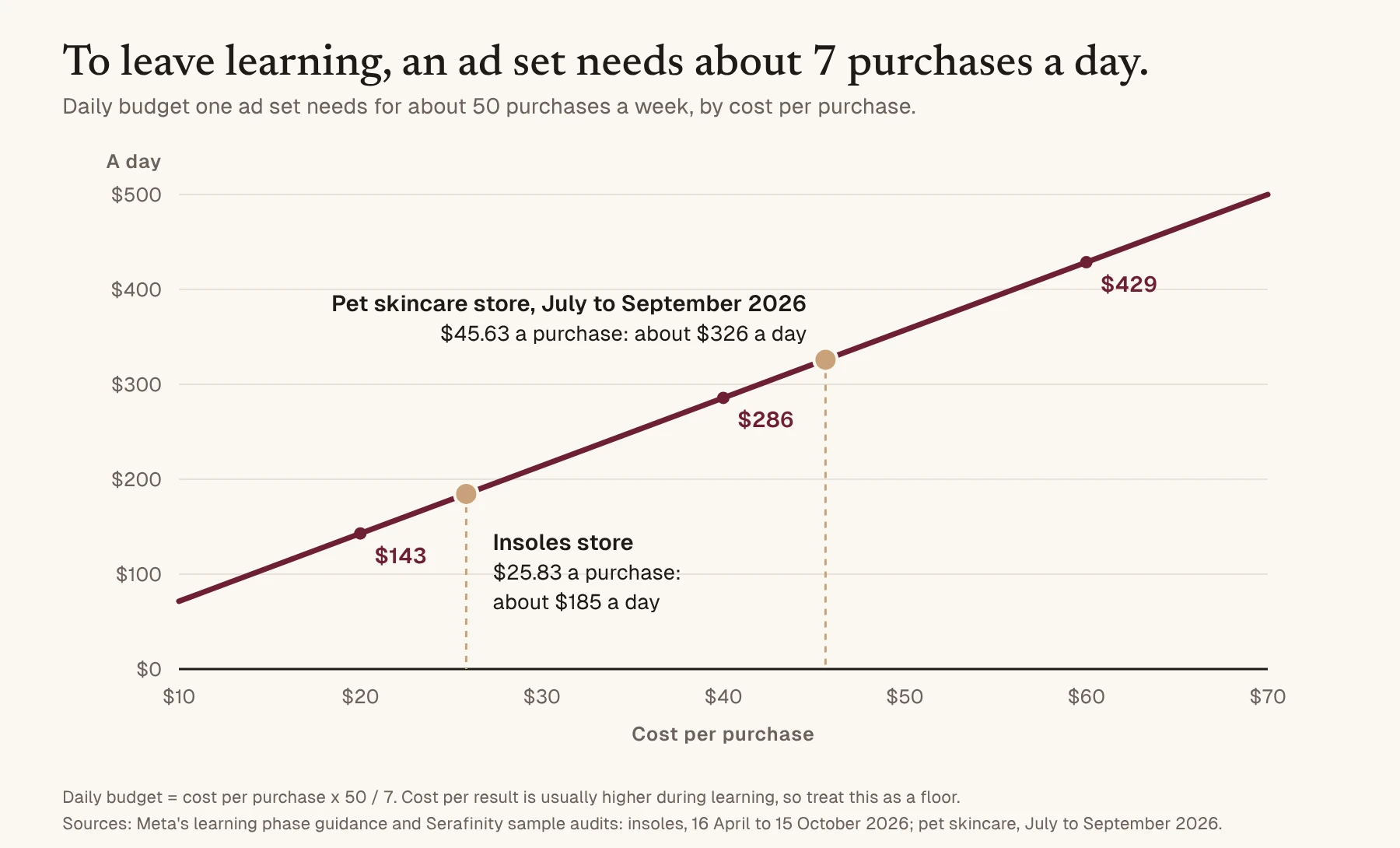
- A low budget. About 50 purchases a week is about 7 a day. At $40 a purchase, that is about $286 a day for one ad set.
- A low bid or cost control. If a cost cap or bid cap sits below what results cost, the ad set can't buy enough of them. Ads Manager shows a tooltip on the status when this is the cause. Why is my Meta campaign not spending its full budget? shows a cost cap doing this in a real account.
- High auction overlap. Your own ad sets compete for the same people.
- A rare optimization event. Purchases of a high-priced product, or a lead stage few people reach.
- Too many ads at once. Meta's learning phase page says the delivery system learns less about each ad and ad set when you run many of them. How many ads should you put in a Meta ad set? looks at the ad count.
In three of our published sample audits, the main cause was the account itself: too many similar ad sets, and too many restarts.
Is Learning limited bad?
Not on its own, but it usually costs money. Meta's help page says learning limited "isn't a penalty". It is a sign that the budget isn't being spent as well as it could be, because the delivery system can't optimize with the current setup.
In October 2026 Meta put a number on it. Its peak-season advice told advertisers to give each ad set roughly 50 conversions a week, and said that in its analysis, "ad sets under that threshold ran about 28% more expensive per purchase."
Read that number with care. Meta published no method or sample with it, and ad sets under 50 a week tend to be the smaller ones, which can cost more for other reasons. It shows the direction, not what merging your own ad sets will save. In a lead generation account we audited, Meta's recommendations were more specific: they estimated a 20% lower cost per completed assessment from combining 4 similar ad sets. That is Meta's estimate, not a measured result.
So judge the ad set, not the label. If a learning limited ad set meets your cost per purchase or ROAS target, the label alone isn't a reason to rebuild it, because every rebuild starts learning again. If it misses, look at the setup before you look at the ads.
How many ad sets can my budget support?
As many as can each get about 50 results a week: your weekly budget divided by 50 times your cost per result. That is Meta's own formula, and it allows fewer ad sets than most accounts run.
Weekly budget ÷ (cost per result × 50) = the most ad sets your budget can support
| Weekly budget | Cost per purchase | Most ad sets |
|---|---|---|
| $1,000 | $20 | 1 |
| $5,000 | $40 | 2 |
| $10,000 | $25 | 8 |
| $28,675 | $25.83 | 22 (the insoles store) |
Meta's post adds that most accounts run more ad sets than that. The insoles store is one of them. It spent $749,655 over the 26 weeks from 16 April to 15 October 2026, about $28,675 a week, at $25.83 a purchase. That bought about 1,110 purchases a week, enough for about 22 ad sets to get 50 each. In those six months 361 ad sets spent money, across 45 campaigns, 38 of them created in the window. Not all of them ran at the same time. But among Meta's own recommendations for the account were 13 to merge overlapping ad sets, one of them to "combine 50 similar ad sets affected by fragmentation". The audit's plan runs the store on six campaigns at $5,000 a day.
Meta's own example of fragmentation is three ad sets with the same objective and creative, aimed at people interested in dogs, in dog toys and in dog collars. Splitting the audience three ways can lower performance, and Meta suggests one ad set with all three interests instead. Its learning phase page puts the reason plainly: "When you combine similar ad sets, you also combine learnings."
How much budget does an ad set need to exit learning?
About 50 times your cost per result a week, or about 7 results a day. The chart above shows it for purchases.
- At the insoles store's $25.83 a purchase, one ad set needs about $185 a day.
- At the pet skincare store's $45.63 in the third quarter of 2026, it needs about $326 a day.
Treat those as the floor. Meta says cost per result is usually higher during learning, so the first week costs more than the average.
Cheaper events need far less. In the lead generation account, a completed website assessment cost $4.79 in Canadian dollars, so 50 a week cost about $240, or $34 a day. That is why a rarer, more valuable event is a step to take once the volume is there. The audit's plan moves the website ad sets to Meta's qualified-lead goal only once they get a steady weekly flow of qualified leads, with Meta's 50 a week per ad set as the guide.
What restarts the learning phase?
Any significant edit to the ad set. Meta lists these:
- Any change to targeting
- Any change to ad creative
- Any change to the optimization event
- Adding a new ad to the ad set
- Changing the bid strategy
- Pausing the ad set for 7 days or longer: it starts learning again when you switch it back on
Budgets, spending limits and bid, cost or ROAS goals count only when the change is large. Meta's example: $100 to $101 isn't likely to restart learning, $100 to $1,000 may. Meta's page gives no percentage. With Advantage+ campaign budget, changing the campaign's budget or bid strategy can send several ad sets back into learning at once. Adding a new ad set to the campaign doesn't send the others back.
In the audits, the edits added up:
- The insoles store. On the 153 days of the window its activity log returned, budgets changed 258 times, 1.7 a day. On the 106 days its campaign log covered, 27 campaigns were created and campaigns were switched on or off 56 times.
- The lead generation account. Budgets changed 86 times on 35 days, and the account was dark for 27 of its 183 days after both running campaigns were switched off. Each restart put Meta back into learning.
- The pet skincare store. Four account structures in nine months. Each one launched new campaigns, new ad sets and new ad IDs for creative that already had history, and the same video ran under three ad IDs in three campaigns.
How long do Meta ads stay in the learning phase?
Until the ad set can deliver stably, which Meta says usually happens after about 50 results in the week after its last significant edit. There is no fixed number of days. An ad set that reaches 50 results in a few days can leave early. One that never gets 50 in a week stays stuck at learning limited until its budget, audience or structure changes, or until it collects enough results.
When an audit plans a structural change, we allow for seven to ten days of unstable delivery after each one, as in the pet skincare plan. That plan also spaces the big changes out rather than making them all at once, so each one can be read.
How do I fix Learning limited on Meta ads?
Give each ad set enough results to learn from: fewer, broader ad sets, each funded for about 50 results a week, and fewer edits. Check first that the label matters.
- Compare it with your target. If the ad set meets your cost per purchase or ROAS target, leave it. Every fix is a significant edit.
- Add the right columns. In Ads Manager, open Columns, then Customize columns, and add Last significant edit, Results and Optimization events. Results since the last significant edit show how far each ad set is from 50.
- Run Meta's formula. Weekly budget ÷ (cost per result × 50). If you run more ad sets than it allows, you have more ad sets than your budget can teach.
- Combine similar ad sets. Merge ad sets with the same objective and similar audiences into one broader one. Meta's recommendations in Account Overview may name them, and Meta offers an automated rule that combines ad sets when it detects fragmentation. To keep the detail for reporting, use breakdowns such as age, gender and country instead of separate ad sets.
- Broaden the audience. Meta's reasoning is simple: a larger audience gives more people the chance to complete your optimization event.
- Fund each ad set for about 7 results a day. If you raise budgets, do it in a few planned steps rather than many small edits. In the designer streetwear audit, each step raises the budget by about a fifth and holds for at least a week.
- Check bid and cost controls. If the tooltip on the status says the cap is the cause, raise it or remove it.
- Change the optimization event only with care. Meta suggests a more frequent event, for example add to cart instead of purchase. That brings more results, but Meta then looks for people likely to add to cart, not to buy. It suits stores where add to carts turn into purchases at a steady rate.
- Group your changes. Meta's peak-season advice is to make every change to an ad set in one go, so it goes through one learning phase rather than several, then leave it alone. A week is a sensible minimum.
- Freeze before Black Friday. Launch the sale ad sets and ads the week before, then stop. The designer streetwear plan makes no new ad sets, new ads or audience changes from 24 to 30 November, and raises the peak budget in one move on 27 November. For how much to spend, see should I increase my Meta ads budget for Black Friday?
Questions owners ask next
Does adding a new ad reset the learning phase?
Yes. Meta lists adding a new ad to an ad set as a significant edit, as is any change to an ad's creative. That is one reason the insoles plan tests new ads in a separate creative testing campaign and moves only the winners into prospecting, each as one ad.
Does a 20% budget increase reset learning?
Meta doesn't use a percentage. Its page says a budget change may or may not be significant "depending on the magnitude of the change", with $100 to $101 unlikely to matter and $100 to $1,000 likely to. Fewer, planned budget steps are safer than frequent ones.
Should I duplicate a learning limited ad set?
Usually not. A copy starts learning from zero and splits the same results across more ad sets, which is the problem learning limited points to. In the insoles store, 10 campaigns named as duplicates or copies spent $15,948 at a ROAS of 1.62, below the account's 1.71.
Can a learning limited ad set still make money?
Yes. Meta keeps delivering it, and the label says nothing about profit on its own. Judge it on cost per purchase and ROAS, and change it only when those miss.
About this data
The account figures come from four Serafinity sample audits, each published with the client's permission and anonymised: a direct-to-consumer insoles brand ($749,655 of spend and 29,027 purchases from 16 April to 15 October 2026; sections 4 and 16), a direct-to-consumer pet skincare brand (about $145,000 of spend from 1 January to 30 September 2026; sections 2, 4 and 17), a lead generation account ($39,817 in Canadian dollars from 2 April to 1 October 2026; sections 4 and 7) and a designer streetwear store ($111,815 of spend from 11 May to 10 November 2026; sections 20 and 21).
All account figures are as Meta reports them. ROAS is purchase value divided by spend. The insoles store's weekly budget is its spend over the 26.1 weeks of the window. The daily budgets in the chart are arithmetic on Meta's 50-results guidance and leave out the higher costs of the learning phase. Meta's figures are from its Business Help Centre pages on the learning phase, learning limited, significant edits and combining ad sets, checked on 18 November 2026, and from its peak-season post of 21 October 2026. You can read the insoles, pet skincare, lead generation and designer streetwear sample audits. Serafinity audits accounts and does not run them.
Sources
- Serafinity, "Meta Advertising Audit and 90-Day Scale Plan," sample audit of a direct-to-consumer insoles brand, 19 October 2026, sections 4 and 16. https://serafinity.com/sample-audit-d2c-insoles.pdf
- Serafinity, "Meta Advertising Audit and 90-Day Scale Plan," sample audit of a direct-to-consumer pet skincare brand, 2026, sections 2, 4 and 17. https://serafinity.com/sample-audit-petcare.pdf
- Serafinity, "Meta Advertising Audit: Ad Account and Funnel Inspection," sample audit of a lead generation account, October 2026, sections 4 and 7. https://serafinity.com/sample-audit-lead-generation.pdf
- Serafinity, "Meta Advertising Audit and 90-Day Scale Plan," sample audit of a designer streetwear store, 11 November 2026, sections 20 and 21. https://serafinity.com/sample-audit-designer-streetwear.pdf
- Meta, "About learning limited," Meta Business Help Centre, checked 18 November 2026. https://www.facebook.com/business/help/269269737396981
- Meta, "About the learning phase for ad sets in Meta Ads Manager," Meta Business Help Centre, checked 18 November 2026. https://www.facebook.com/business/help/112167992830700
- Meta, "Significant edits and learning phase," Meta Business Help Centre, checked 18 November 2026. https://www.facebook.com/business/help/316478108955072
- Meta, "Combine ad sets and campaigns in Meta Ads Manager to reduce audience fragmentation," Meta Business Help Centre, checked 18 November 2026. https://www.facebook.com/business/help/2419480091640105
- Meta for Business, "Peak Season 2026: You Don't Beat The Auction. You brief it.," 21 October 2026. https://www.facebook.com/business/news/you-dont-beat-the-auction-you-brief-it
Want this checked on your own account?
Serafinity audits Meta ad accounts read-only. Your audit arrives in 2 to 5 working days, or in 24 hours if you need it sooner. See audit pricing.