Ad costs
Why is my CPM so high on Meta ads?
Mostly because more advertisers are bidding for the same people, especially before Black Friday, and partly because of your own audience, ads and setup. Meta's price per ad rose 14% in a year. A high CPM only hurts if cost per purchase rises with it: in one store we audited, CPM more than doubled but a sale cost only 1.49 times as much.
What sets your CPM on Meta?
An auction, run every time someone could be shown an ad. The more advertisers want that person, and the better their ads, the more it costs to win.
CPM, cost per mille, is the amount spent divided by impressions, times 1,000. If you spend $50 and get 10,000 impressions, your CPM is $5. Facebook and Instagram ads are bought in the same Meta auctions: one runs for each impression, and every ad whose target audience includes that person can compete in it.
The winner isn't simply the highest bidder. Meta picks the ad with the highest total value, from three things: the advertiser's bid, an estimate of how likely the person is to take the action the advertiser wants, and the ad's quality, judged partly from people hiding it and from signs such as engagement bait. Meta says a more relevant ad "could win an auction against ads with higher bids". Its help page also mentions a price floor and adjustments for regional costs.
So CPM rises for three kinds of reasons:
- More competition for the same people. More advertisers, bigger budgets, or a season like Black Friday.
- Pricier people and places. Some countries, audiences and placements cost more to reach, and a narrow audience leaves Meta fewer cheap impressions to choose from.
- Less relevant ads. If Meta expects fewer people to act on your ad, or people hide it, it has to pay more to win the same impression.
You control some of these and not others. The next sections show each one in real accounts.
Is everyone paying more for Meta ads in 2026?
On average, yes. Meta's own results say so, and both stores below paid much more in 2026.
In its results for the third quarter of 2026, Meta reported that its average price per ad "increased by 14% year-over-year", while ad impressions grew 10%. That is the whole market: prices rose faster than the number of ads Meta showed.
Individual accounts can move far more than the average.
- The insoles store. Its CPM sat between $8.91 and $10.83 in six of the eight quarters of 2024 and 2025, then climbed through 2026 to $20.79 in the third quarter. From 16 April to 15 October 2026, 1,000 impressions cost $20.36, 2.23 times the $9.13 of the same dates in 2024.
- The pet skincare store. Its CPM went from $27.25 in the first quarter of 2026 to $42.91 in the third, up 57%. Most of the step came in one month: $35.15 in March, $45.94 in April, and it never came back.
Why is my CPM higher in November?
Because Black Friday brings more advertisers into the same auctions. The insoles store paid 42% to 68% more per 1,000 impressions at the peak.
| Period | CPM | ROAS | Cost per purchase |
|---|---|---|---|
| Four weeks before, 2024 | $10.52 | 1.80 | $19.34 |
| Thanksgiving to Cyber Monday, 2024 | $17.70 | 1.37 | $26.16 |
| January after, 2025 | $8.01 | 1.75 | $20.78 |
| Four weeks before, 2025 | $14.35 | 1.26 | $38.29 |
| Thanksgiving to Cyber Monday, 2025 | $20.42 | 1.25 | $39.74 |
| January after, 2026 | $12.24 | 1.43 | $33.10 |
In 2024 the peak cost 68% more per 1,000 impressions than the four weeks before, and ROAS fell from 1.80 to 1.37. In 2025 the peak cost 42% more and ROAS held at 1.25, the lowest of any period in the table. Both years, January was cheaper than the weeks before Black Friday.
If you are deciding how much to spend this year, see should I increase my Meta ads budget for Black Friday?
Is a high CPM always bad news?
No. What matters is your cost per purchase, and CPM is only one of the numbers behind it.
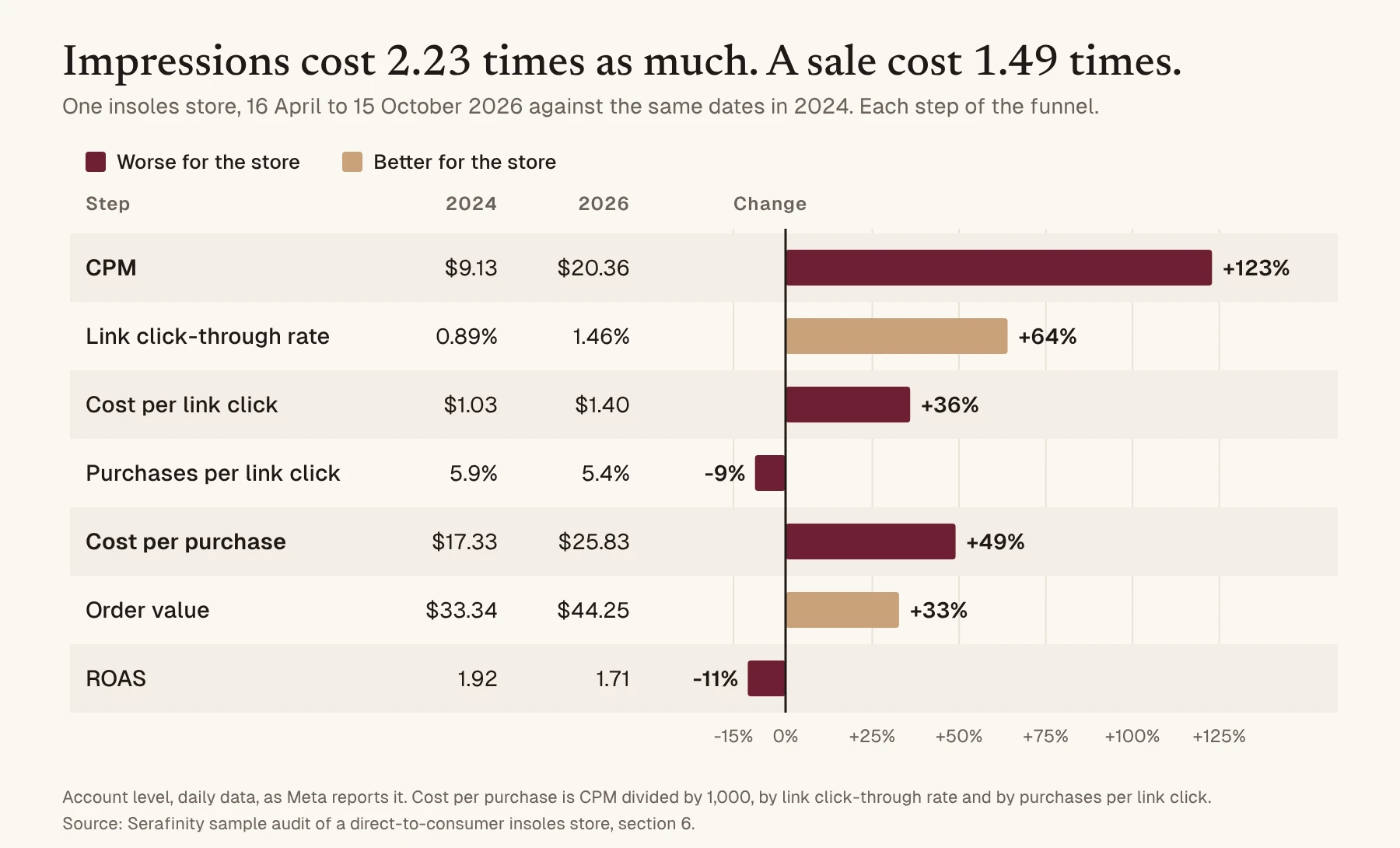
A purchase costs the price of 1,000 impressions, divided by the share of impressions that become clicks, divided by the share of clicks that buy. ROAS then depends on how big the orders are. Here is the insoles store, the same six months two years apart:
| Step | 16 Apr to 15 Oct 2024 | 16 Apr to 15 Oct 2026 | Change |
|---|---|---|---|
| CPM | $9.13 | $20.36 | +123% |
| Link click-through rate | 0.89% | 1.46% | +64% |
| Cost per link click | $1.03 | $1.40 | +36% |
| Purchases per link click | 5.9% | 5.4% | -9% |
| Cost per purchase | $17.33 | $25.83 | +49% |
| Order value | $33.34 | $44.25 | +33% |
| ROAS | 1.92 | 1.71 | -11% |
The price of impressions alone would have made a purchase 2.23 times dearer. More people clicking took a large part of that back, and slightly fewer buyers per click added a little. The result: a purchase cost 1.49 times as much, and because orders were a third bigger, ROAS fell only 11%. The auction got more expensive, but people wanted the ads more, not less.
The pet skincare store shows the other case. From the first quarter of 2026 to the third, CPM rose 57%. Link click-through rate barely moved, down 3% from 1.71% to 1.65%. Fewer clicks turned into purchases, 5.69% against 6.50%, and the average order fell 7%. Nothing after the impression improved to pay for the dearer auction, so cost per purchase went from $24.48 to $45.63 and ROAS halved, from 2.10 to 1.05, while spend rose four times.
Same problem, two outcomes. The difference was what happened after people saw the ad.
Does a cheaper CPM mean cheaper sales?
Not necessarily. In the insoles store, the markets with the cheapest impressions sold for about the same price per purchase.
| Market | CPM | Link CTR | Purchases per click | Cost per purchase | ROAS |
|---|---|---|---|---|---|
| Main market | $22.13 | 1.46% | 5.9% | $25.91 | 1.72 |
| Market B | $14.54 | 1.52% | 3.8% | $24.90 | 1.62 |
| Market C | $12.53 | 1.53% | 3.2% | $25.72 | 1.69 |
| Market D | $14.31 | 1.27% | 4.4% | $25.44 | 1.76 |
Impressions in the other three markets cost 34% to 43% less, but fewer of the people who clicked bought. A purchase ended up costing within about $1 of the main market everywhere.
The ad format changes CPM too. In the US skincare store from INSIDE THE ACCOUNT S1E3, videos cost $27.04 per 1,000 impressions and static images $11.55. There the dearer format also returned less, a ROAS of 1.73 against 2.26. Either way, the CPM on its own didn't say which was better. The result per purchase did.
What in my own account can push CPM up?
Four things showed up in these audits and in Meta's own troubleshooting guide: where you advertise, how narrowly you target, what you run, and how often you rebuild.
- Country and placement. The insoles store paid $22.13 in its main market and $12.53 to $14.54 elsewhere. A CPM rise can simply mean more of your budget moved to a pricier market or placement.
- Narrow audiences and few placements. Meta's guide to high costs recommends a broader audience and more placements, which give its system more people to find cheaper results among. It also advises against cutting an audience or placement just because it has looked expensive so far, since the system already goes for the cheapest opportunities first.
- Format and relevance. Video cost more than twice as much per 1,000 impressions as static images in the S1E3 store. Meta's auction also counts how likely people are to act on the ad and how they react to it, so a tired or low-quality ad pays more to win the same person. S1E2 looks at what Meta's quality ranking tells you.
- Many small, new ad sets. In April the pet skincare store opened a new structure of creator ad sets on small daily budgets, at a CPM of $74.16. That was the month its CPM stepped up for good. It ran four different account structures in nine months, and each one started again with new campaigns, ad sets and ad IDs.
How do I lower my CPM on Meta ads?
First find out whether it matters, then fix the parts you control. Meta's own troubleshooting guide starts with the learning phase, and so should you.
- Let the ad set leave the learning phase. Meta says performance is less stable while an ad set is learning, so its costs don't yet predict what comes next. Judge a new ad set once it has settled.
- Check cost per purchase and ROAS. If they held, a higher CPM is being paid for by the rest of the funnel. Leave it.
- Compare the same dates last year. CPM is seasonal, so November against October will always look bad. Set the date range to the same dates a year earlier and compare.
- Split the rise into its parts. Add the columns CPM (cost per 1,000 impressions), CTR (link click-through rate), CPC (cost per link click), Link clicks, Purchases, Cost per purchase and Purchases conversion value. Purchases divided by link clicks gives purchases per click, and conversion value divided by purchases gives order value. The step that moved most is where to look.
- Break it down by country and placement. In Breakdown, under By delivery, choose Country, then Placement. If one market or placement carries the rise, decide whether its sales justify it.
- Give Meta room. Broaden the audience and keep Advantage+ placements on rather than cutting the markets or placements that look expensive.
- Improve the ads and what happens after the click. Meta says the quality and relevance of the creative and the post-click experience "directly impact the price you pay". Replace ads Meta marks as Creative fatigue, make the product page match the ad, and lift order value with bundles or a free-shipping threshold. In the insoles store, more clicks and bigger orders absorbed most of a doubled CPM.
- Check your tracking. If your Meta pixel or Conversions API misses purchases, your cost per purchase looks higher than it is.
- Don't rebuild because CPM rose. New structures start learning again. The pet skincare store ran four structures in nine months, and its CPM never returned to its March level.
- Plan Black Friday at peak prices. Assume impressions cost 40% to 70% more from Thanksgiving to Cyber Monday, as in the insoles store, and work out the ROAS you need to break even at that price before you raise budgets.
Questions owners ask next
What is a good CPM for Meta ads?
There isn't one number. The insoles store paid anything from $8.01 to $22.13 per 1,000 impressions depending on the year, the season and the market. Compare your CPM with your own account over the same dates last year, and judge it by what a purchase costs.
Is a $20 CPM high?
Not unusual in these accounts. The insoles store paid $20.36 per 1,000 impressions in 2026 and still made a ROAS of 1.71. The US skincare store paid $27.04 for video, and the pet skincare store $42.91 in the third quarter of 2026. Whether $20 is too much depends on what a purchase costs you at that price, not on the CPM itself.
Will my CPM come down after Black Friday?
In the insoles store it did. January's CPM was $8.01 in 2025 and $12.24 in 2026, against $17.70 and $20.42 at the peak. Both Januarys were cheaper than the four weeks before Black Friday.
Is my CPM high because of my ads?
Partly, it can be. Meta's auction rewards ads it expects people to act on and counts it against ads people hide, so a weak ad pays more for the same impression. But if your CPM rose across every ad at once, the market moved, not your ads.
About this data
The figures come from two Serafinity sample audits, each published with the client's permission and anonymised: a direct-to-consumer insoles brand ($749,655 of spend from 16 April to 15 October 2026, compared with the same dates in 2024; sections 4, 6 and 18) and a direct-to-consumer pet skincare brand (about $145,000 of spend from 1 January to 30 September 2026; sections 2 and 4). The format figures come from the US skincare account in INSIDE THE ACCOUNT S1E3, over a recent 30-day window.
All account figures are as Meta reports them, at account level from daily data. ROAS is purchase value divided by spend. The insoles store's other markets are named only as B, C and D in its audit. Meta's figures are from its third-quarter 2026 results, released on 21 October 2026, and its Business Help Centre pages on ad auctions, CPM and high costs, checked on 18 November 2026. You can read the insoles and pet skincare sample audits. Serafinity audits accounts and does not run them.
Sources
- Serafinity, "Meta Advertising Audit and 90-Day Scale Plan," sample audit of a direct-to-consumer insoles brand, 19 October 2026, sections 4, 6 and 18. https://serafinity.com/sample-audit-d2c-insoles.pdf
- Serafinity, "Meta Advertising Audit and 90-Day Scale Plan," sample audit of a direct-to-consumer pet skincare brand, 2026, sections 2 and 4. https://serafinity.com/sample-audit-petcare.pdf
- Serafinity, "INSIDE THE ACCOUNT S1E3: Does a higher CTR mean a higher ROAS?," 17 November 2026. https://serafinity.com/blog/ctr-vs-roas
- Meta Platforms, "Meta Reports Third Quarter 2026 Results," 21 October 2026. https://investor.atmeta.com/investor-news/press-release-details/2026/Meta-Reports-Third-Quarter-2026-Results/default.aspx
- Meta, "About ad auctions," Meta Business Help Centre, checked 18 November 2026. https://www.facebook.com/business/help/430291176997542
- Meta, "CPM (cost per 1,000 impressions)," Meta Business Help Centre, checked 18 November 2026. https://www.facebook.com/business/help/753932008002620
- Meta, "Troubleshoot ad performance: your costs are too high," Meta Business Help Centre, checked 18 November 2026. https://www.facebook.com/business/help/2727273724224874
More answers
Should I increase my Meta ads budget for Black Friday 2026?
In a real audit, Black Friday week to Cyber Monday made a ROAS of 12.27 on 28% more spend a day than the four weeks before. How to set your 2026 Meta budget.
Why did my ROAS drop when I increased my Meta ads budget?
In one audit, spend over $5,000 a day returned 1.26, then 1.02, against a 1.39 break-even. Why ROAS drops as you increase a Meta budget: diminishing returns.
INSIDE THE ACCOUNT S1E3: Does a higher CTR mean a higher ROAS?
We ranked 30 ads in a US skincare store by CTR and by ROAS. The five highest-CTR ads returned 1.77, the five lowest 2.73. What lined up with sales instead.