Creative testing
How many ads should you put in a Meta ad set?
Five at most, and five that differ from each other. That is Meta's own recommendation, and budget sets the real limit: every new ad needs enough spend to be judged, so an ad set that can't fund five fair tests should run fewer.
What does Meta recommend?
No more than five ads in each ad set, and five that differ. Meta's guide to ad set structure says: "We only recommend including images or videos that are distinct from each other. We recommend running no more than five ads per ad set for optimal delivery."
An ad set is the level where you choose the audience, the budget and the schedule, and every ad inside it shares that budget. Five is a recommendation, not a limit: Ads Manager lets you have "up to 50 ads in each ad set".
Why do too many ads hurt?
Because they cut one budget into pieces too small to learn from. Meta's help page on ad volume says: "When an advertiser runs too many ads at once, each ad delivers less often. This means that fewer ads exit the learning phase, and more budget is spent before the delivery system can optimize performance."
The learning phase is the period when Meta's delivery system is still working out whom to show an ad set to. It usually ends "after about 50 results in the week after the ad set's last significant edit", and Meta's page on it adds: "When you create many ads and ad sets, the delivery system learns less about each ad and ad set than when you create fewer ads and ad sets."
Meta doesn't tell you to stop testing. "Testing new creative and marketing strategies is still important," the ad volume page says, but advertisers "should balance these tactics with ensuring that the delivery system has ample opportunity to learn about each ad."
What happens in a real account with too many ads?
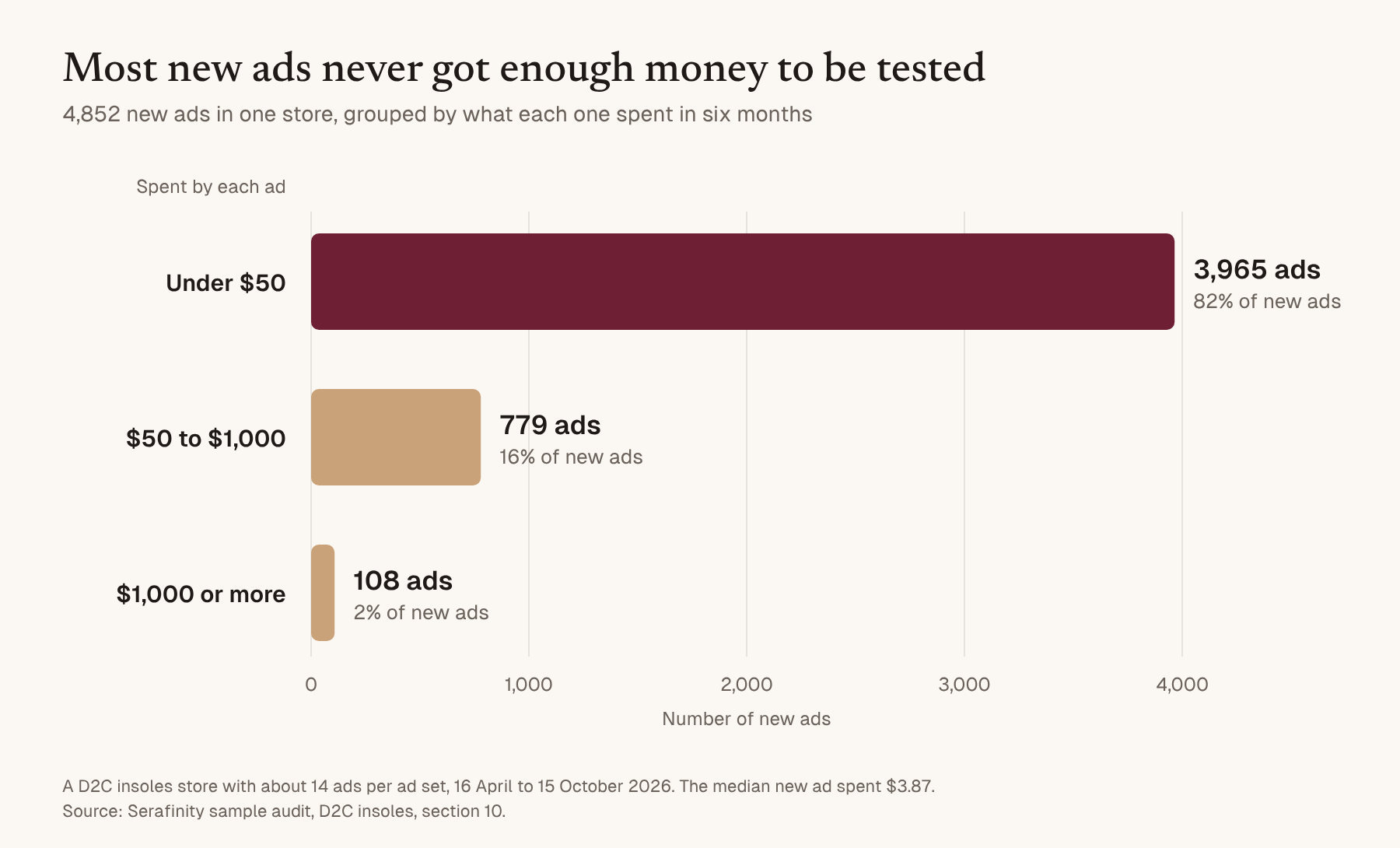
Most of the ads never get a test. A Serafinity sample audit of a direct-to-consumer insoles brand counted 5,094 ads with spend in 361 ad sets over six months, about 14 ads per ad set. Of the 4,852 ads created in that time, 3,965, or 82%, spent under $50. The median new ad spent $3.87, and only 108 reached $1,000.
The audit's name for this was "testing is a lottery". The account did find winners: 186 new ads reached ten or more purchases at or under the account's cost per purchase, and together they took 57% of the spend at a ROAS of 1.89. ROAS is the sales Meta credits to the ads for each dollar they cost. But in the audit's words, "an ad that never got $50 has not been tested".
The volume cost more than money. The ads filled the Page's ad limit, so 19 were stopped with the notice "your ad limit for this Page has been reached".
A UK gadget brand shows the same pattern on a smaller budget. 131 new ads launched in 2026 shared £11,515, an average of £88 each, and 100 of them spent under £50. Only 15 reached 10 orders, and as that audit puts it, "A test that ends before 10 orders has not tested anything."
Did Meta's Andromeda update change the number?
No. Andromeda changed how Meta picks which ads to consider for each person, not how much budget each ad needs to prove itself. It is the step where Meta narrows "a pool of tens of millions of ads to the few thousand we consider showing someone", and Meta says that as advertisers upload more creatives "to support a diversification strategy", it helps Meta "pick the right creative". An October 2026 upgrade lets it score every eligible ad, and Meta's engineers say that "Since 2025, Meta Andromeda has delivered a 2.4% increase in conversions on Facebook."
Some advice since Andromeda says to load 20 or more ads into one ad set. We found no published data behind it, and Meta's own pages haven't moved: the ad set structure guide still says five, and the ad volume page still says "too many ads can result in worse performance". In September 2026 a Meta spokesperson told Marketing Brew that diversifying creative is a "longstanding best practice as we see it deliver measurable results". Diversity, not volume.
What counts as a different ad?
A different idea or a different format. Five versions of the same video count as one ad to Meta's system, and they compete for the same people. Meta's guide to creative variety explains why: "When creative is too similar, our system may not recognize it as different and could deliver it to the same sets of audiences. This overlap limits your reach and ultimately leads to Creative limited or Creative fatigue status." Both are delivery statuses in Ads Manager.
Meta now measures this for you. Its Creative diversity metric, which it labels "estimated and in development", is "calculated by comparing the images and video thumbnails in your ad set to each other to determine similarity", then rated High, Medium or Low. Meta says it shows "if more varied images and videos need to be added to an ad set". It rates how different the ads are, not how many there are.
Advertisers told Marketing Brew in September 2026 that Meta's advice is to mix video and static ads and to use different hooks, and that an ad with the same look or the same opening hook as another is treated as the same ad. The hook is the first line or first seconds of the ad.
Which five ads should you run?
Five different formats on one angle, such as two images, two videos and one carousel. An angle is the reason to buy that the ad leads with, such as comfort, price or proof. Mixed formats give Meta's system five ads it can tell apart.
In the insoles store, video took 78% of the spend at a ROAS of 1.71, while images, carousels and catalogue ads took 22% at 1.72, with a larger average order of $47.07. Stills earned as much per dollar on far less money, which the audit calls "a reason to fund stills properly in testing". In the gadget store, a single carousel ran at £3.51 an order, the cheapest in the account, on 4.5% of the spend: thin evidence, the audit says, but enough to make more carousels.
Both audits' plans are built this way. The gadget plan tests in "Five ad sets at £80 once there are enough ads, one angle per ad set, 5 to 6 ads each: images, carousels, videos."
How much should a new ad spend before you turn it off?
Enough to show what it does, which for most stores means several purchases' worth. The insoles plan gives every new ad "up to $150 before it is judged, about six purchases at today's cost", and switches it off early "at $75 with no purchase". A winner is an ad with ten or more purchases at or under the target cost. The gadget audit draws the same line at 10 orders.
That turns into a quick budget check:
- Find what one test costs. Multiply your cost per purchase by six. That is roughly what each new ad needs before you judge it.
- Divide your weekly testing budget by it. The answer is how many new ads you can judge in a week.
- Set the ad count from that. Under five, put fewer ads in the ad set. Well over five, add an ad set with a new angle rather than more ads in the first one.
For example, at $30 a purchase each new ad needs about $180, so five new ads need $900 a week, about $129 a day. In the insoles store, a testing budget of $4,200 a week covered 15 new ads at $150 each.
The same arithmetic caps your ad sets. Meta's Peak Season guidance gives the formula: "Total weekly budget ÷ (cost per result × 50) = the most ad sets your budget can support". At $30 a purchase, each ad set needs $1,500 a week to reach 50 purchases.
What if a new ad gets no spend?
You can push delivery to it. In an ad's settings, under Schedule, Ads Manager has a switch called Push delivery to this ad, which Meta describes as a way to "help ensure your ad gets delivery by dedicating budget to it". It sets part of the daily budget aside for that ad for a set number of days, so a new ad gets a fair test instead of being starved by the ads the system already favours.
It is an option for new ads, not a switch to turn on for every ad. Once a new ad has had its share, judge it on its own results.
So how many ads should you put in an ad set?
Five, if your budget can judge them, and fewer if it can't. Meta's guidance before and after Andromeda and both 2026 audits point the same way:
- Cap each ad set at five ads. Nothing we found argues for more.
- Make the five differ. Two images, two videos and one carousel. Copies don't count.
- Keep one angle per ad set. A new angle gets a new ad set, if the budget can carry it.
- Fund every new ad. About six purchases' worth before you judge it, off at about three with none.
- Switch losers off. Idle ads still count against your Page's ad limit.
- Push delivery when a new ad gets nothing.
Questions owners ask next
Does every ad set need exactly five ads?
No. Five is a ceiling, not a target. Three ads that each get enough spend to be judged teach you more than five that split the same budget into scraps. Add the fourth and fifth when the budget check above says you can fund them.
Can I put more than five ads in one ad set?
Yes, up to 50, but only if the budget can judge every one. At six purchases' worth each, ten ads need sixty purchases' worth of spend. Most stores do better with a second ad set on a new angle.
Should I pause old ads or delete them?
Switch off the ones that lost their test. Meta tells advertisers to keep active ads within "the limit per Page on ads that are running or in review", and in the insoles store the audit found that "Every ad that sits switched on with no spend still counts against the Page's limit".
About this data
The figures come from two Serafinity sample audits, each published with the client's permission and anonymised: a direct-to-consumer insoles brand ($749,655 of spend from 16 April to 15 October 2026; sections 4, 10, 16 and 19) and a UK direct-to-consumer gadget brand (2026; sections 9 and 15). The 14 ads per ad set is 5,094 divided by 361, and the chart's middle bar is 4,852 new ads minus the 3,965 under $50 and the 108 that reached $1,000.
Meta's guidance is quoted from its Business Help Centre, its guides on ad set structure and creative variety, its Peak Season 2026 guidance, its posts on Andromeda and the Push delivery setting in Ads Manager, all checked on 13 November 2026. Advertisers' reports of Meta's advice come from Marketing Brew. Both audits cover 2026, after Andromeda was in use. You can read the insoles and gadget sample audits (PDF), or see what an audit of your own account costs. Serafinity audits accounts and does not run them, so nothing here is a pitch for management.
Sources
- Serafinity, Meta Advertising Audit and 90-Day Scale Plan, D2C insoles sample: section 1 (page 4), section 4 (page 9), section 10 (pages 16 and 17), section 16 (page 24) and section 19 (page 28). https://serafinity.com/sample-audit-d2c-insoles.pdf
- Serafinity, Meta Advertising Audit and 90-Day Scale Plan, D2C gadget sample: sections 9 and 15. https://serafinity.com/sample-audit-d2c-gadget.pdf
- Meta, "Simplify your ad set structure," Meta for Business, checked 13 November 2026. https://www.facebook.com/business/ads/ad-set-structure
- Meta, "About managing ad volume," Meta Business Help Centre, checked 13 November 2026. https://www.facebook.com/business/help/2720085414702598
- Meta, "About the learning phase for ad sets in Meta Ads Manager," Meta Business Help Centre, checked 13 November 2026. https://www.facebook.com/business/help/112167992830700
- Meta, "Campaign, ad set and ad limits per ad account," Meta Business Help Centre, checked 13 November 2026. https://www.facebook.com/business/help/652738434773716
- Meta, "Successful ads tell a story in more ways than one," Meta for Business, checked 13 November 2026. https://www.facebook.com/business/m/small-business/creative-differentiation
- Meta, "Creative diversity," Meta Business Help Centre, checked 13 November 2026. https://www.facebook.com/business/help/2371176336684086
- Meta, "Peak Season 2026: You Don't Beat The Auction. You Brief It.," Meta for Business, 21 October 2026. https://www.facebook.com/business/news/you-dont-beat-the-auction-you-brief-it
- Meta, "AI Innovation in Meta's Ads Ranking Driving Advertiser Performance," Meta for Business, 27 March 2025. https://www.facebook.com/business/news/ai-innovation-in-metas-ads-ranking-driving-advertiser-performance
- Meta Engineering, "Meta Andromeda: Powering the Next Generation of Ads Retrieval Through Model-System Co-Design," 28 October 2026. https://engineering.fb.com/2026/10/28/ml-applications/meta-andromeda-next-gen-ads-retrieval-gpu-co-design/
- Marketing Brew, "How advertisers are adjusting to Meta's ad creative diversification best practices," 28 September 2026. https://www.marketingbrew.com/stories/meta-ad-creative-diversification-best-practices-advertiser-approach
- Meta Ads Manager, ad settings, "Push delivery to this ad," checked 13 November 2026.
More answers
Why did my best Meta ads suddenly stop working?
In one real store, all 8 long-running winners earned less per dollar later; the median lost 28%. How to tell a tired ad from a tired account.
Why is my Meta campaign not spending its full budget?
A £12 cost cap on £21.28 orders left one real account spending £62 of a £100 daily budget. The other reasons Meta underspends, and how to find yours.
How do I scale my Meta ad spend profitably?
In one real store, ROAS rose from 6.36 to 7.90 as spend grew, because autumn orders were bigger. How to read the next dollar and scale in safe steps.