Retargeting
Is retargeting on Meta ads dead in 2027?
Not dead, but the separate retargeting campaign has mostly lost its job, because broad campaigns already reach your site visitors. Across four real accounts, dedicated retargeting beat cold traffic once, by 11% on cost per purchase, and lost twice.
Why does my retargeting cost more than cold traffic?
Because your cold campaign already takes the cheapest warm sales. Retargeting means showing ads to people who visited your site or engaged with your ads. Cold traffic, or prospecting, is everyone else. But broad prospecting with Advantage+ audience, which Meta applies automatically when it's available, isn't limited to cold people. Meta says its AI "is not limited to delivering ads to people who match your selections", and recent visitors are the people most likely to buy.
So the broad campaign reaches the visitors who were about to buy, and gets the credit for them. Meta's own new-customer setting shows the other side. Excluding existing customers and engaged audiences, Meta warns, "may increase your cost per result by reducing your audience size to only new prospects". Part of what makes cold traffic look cheap is the warm buyers inside it.
The streetwear store shows how far this goes. None of its 12 prospecting ad sets kept past buyers out. Four of them were named for retargeting but ran broad targeting, and together they took 70% of the sales spend at a ROAS of 8.66. ROAS is the sales Meta credits to the ads for each dollar they cost.
What happens when retargeting and prospecting chase the same person?
Only one of your ads gets into the auction, and it's rarely the small one. Meta says that when two or more ads from the same advertiser enter the same auction, "we choose the ad with the highest total value to compete in the auction", and the others sit out. Meta calls this auction overlap.
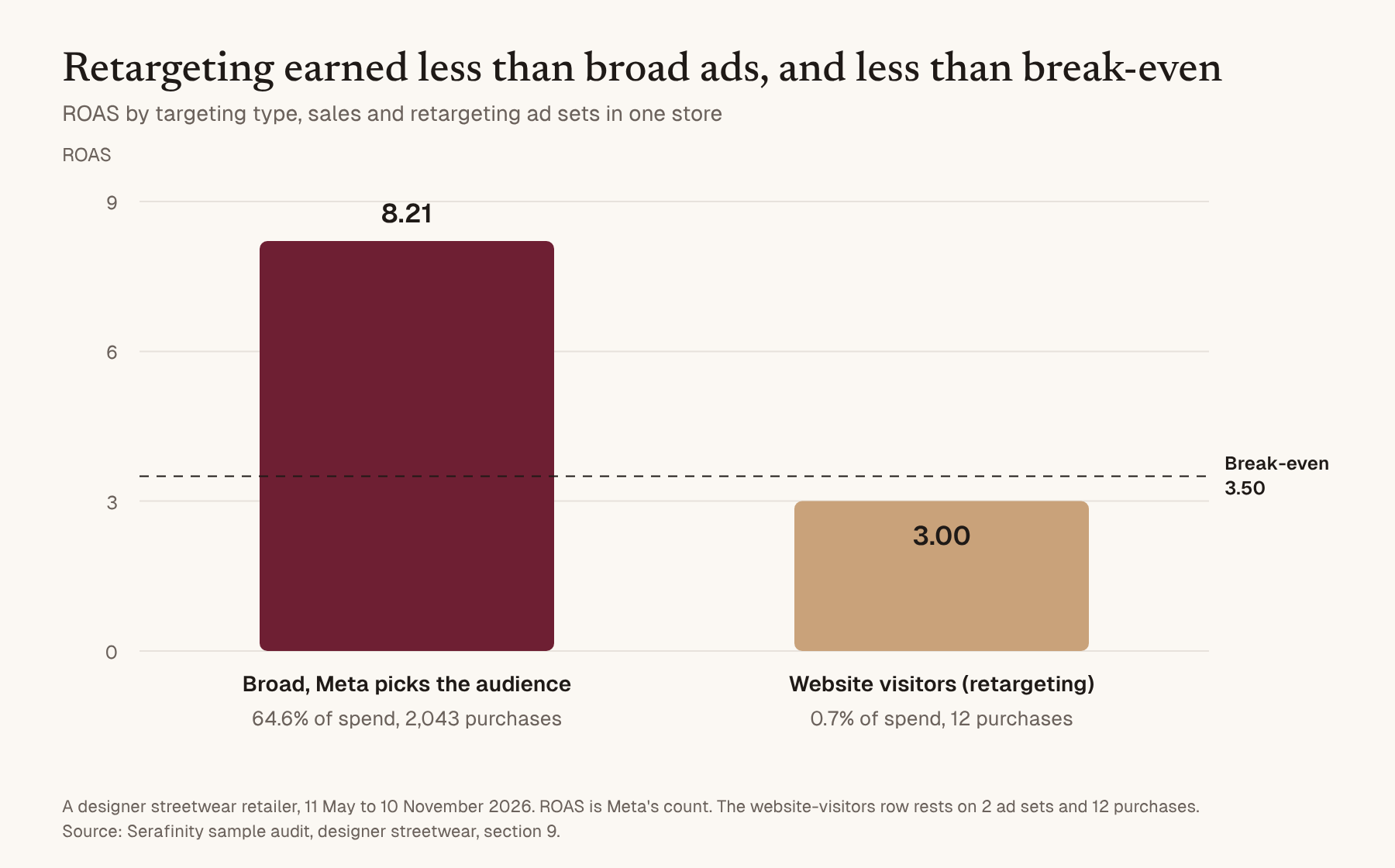
In the streetwear store, the broad ad sets had 2,043 purchases behind them and the visitor ad sets had 12. The retargeting side gets fewer auctions, and Meta warns that overlap "can prevent an ad set from spending its full budget or achieving enough results to exit the learning phase". The learning phase is the period when delivery is still working out whom to show the ads to, and Meta says that during it "cost-per-action (CPA) is usually worse". An ad set needs about 50 results in a week to leave it, and Meta lists small audience size and high auction overlap among the reasons it can't.
Small pools show the strain. The pet skincare account's only retargeting ad set reached 529 people at a frequency of 6.33, meaning each person saw its ads more than six times on average, for 4 purchases. In the streetwear store, Meta reported all 3 website audiences in use at a size of 20.
How did retargeting do in four real accounts?
It won once, lost twice, and in one account was too small to read. These are four Serafinity sample audits. Each compares the ad sets aimed at warm audiences with the cold ones in the same account, on Meta's count:
| Account | Retargeting share of spend | Retargeting | Cold or broad | Verdict |
|---|---|---|---|---|
| Designer streetwear, US | 0.7% | ROAS 3.00 on 12 purchases | ROAS 8.21 on 2,043 purchases | Lost, and below break-even |
| D2C insoles | 8.8% | $23.16 a purchase, ROAS 1.82 | $26.12 a purchase, ROAS 1.70 | Won, 11% cheaper |
| D2C gadget, UK | 3.3% | £10.10 an order | £8.76 an order, launched the same day | Lost, 15% dearer |
| Pet skincare | 0.13% | ROAS 1.48 on 4 purchases | Not compared | Too small to read |
The insoles win says the most. Meta's industry benchmark put that store's retargeting cost per result 56% below similar advertisers for website visitors, so it was a healthy programme. It still came in only 11% cheaper than the cold ad sets, and none of those 358 cold ad sets excluded anyone. The cold side was reaching warm people too.
The gadget comparison ran with audience expansion on, which lets Meta go beyond the chosen audience, so the audit doesn't treat it as a clean test. The streetwear row rests on 12 purchases. Four accounts point the same way, but they are four accounts, not a survey.
Do retargeting ads bring in sales that would happen anyway?
Often, yes. A sale Meta credits to a retargeting ad is not proof the ad caused it. Ads Manager gives the credit for a conversion "to the last ad that the person clicked or interacted with", or to the last ad viewed if there was no click. Someone who was already coming back to buy sees one last ad, and that ad gets the sale.
The best test so far is a field experiment published in 2026 in the Journal of Interactive Marketing. Researchers ran it by geography on the Google and Facebook ad networks for a bed-in-a-box mattress brand, across more than $5.7 million of spend. Prospecting brought "large and consistent returns" on both networks, while retargeting brought much lower ones. The researchers argue that platform reports overstate retargeting because they credit purchases people had already planned, and that privacy rules such as iOS 14 and GDPR have cut its effect.
The same pattern shows in credit for views. In the streetwear store, 28% of the purchases Meta credited came within a day of an ad view, with no click. A view-through sale like that often goes to someone who would have bought anyway.
How fast does a retargeting ad stop working after a visit?
Within days. A field experiment published in 2019 in the Journal of Marketing Research, with an online seller of home-improvement products, found that retargeting brought 14.6% more users back to the site within four weeks. A third of the first week's effect, 33%, came on the first day.
Timing can also cut the other way. A 2021 experiment in the Journal of Marketing sent cart reminders by email, app and text message, not Meta ads. Reminders sent 30 minutes to an hour after someone left a cart made them less likely to buy than sending nothing. Reminders sent one to three days later helped.
So a 180-day visitor audience, the longest Meta allows for website visits, is mostly people an ad can no longer move. The pet skincare account's only retargeting audience was carts and checkouts over 180 days, and it reached 529 people.
So is retargeting dead in 2027?
The always-on retargeting campaign is close to it for most stores. Retargeting itself isn't: the job has moved inside broad campaigns, which reach warm people on their own. Meta has moved the same way. Advantage+ sales campaigns used to let advertisers cap the share of budget spent on existing customers, and Meta now says that cap "is no longer available".
What still earns its keep is retargeting that says something new. The pet skincare audit puts the problem plainly: broad Advantage+ campaigns "do some retargeting on their own", but the same ad is shown again "at prospecting CPMs, with no change of message". CPM is the cost of 1,000 impressions. The gadget audit's plan points its cart and checkout ads at the one thing people leave over, the trial terms: what is charged today, what is charged on day 15, and how to cancel.
Past buyers are a different job altogether. In the insoles store, no campaign was aimed at them in six months, though the audit's sources put repeat buying at 15% of first-time buyers within a year. Winning one back by email or a cheap retention ad costs far less than a new customer at $25.83.
How should I set up retargeting on Meta now?
Start from broad and add only what broad can't do. The four audits come to the same setup:
- Keep past buyers out of prospecting. Exclude a current customer list and purchasers from the last 180 days in every prospecting ad set. In the insoles store the 358 cold ad sets didn't, so some repeat orders were likely paid for at a new-customer price.
- Leave visitors in. Don't exclude site visitors from broad prospecting. That is where the cheapest warm sales come from now.
- Turn on audience segments. In Advertising settings, define your engaged audience and your existing customers. The Audience segments breakdown in Ads Manager then splits results into new audience, engaged audience and existing customers, so you can see how much of prospecting goes to people who already know you.
- If you run retargeting, keep the windows short. The gadget plan uses carts and checkouts without an order over 14 days, and visitors and engagers over 30 days, with audience expansion off. The pet skincare plan adds a frequency cap of three a week.
- Give it its own message. Answer the reason people left, not the pitch they already saw.
- Judge it against cold, not on its own. Compare its cost per purchase with the broad ad sets over the same weeks. If it can't beat them, move the money back.
Questions owners ask next
How much of my budget should go to retargeting?
Less than a tenth, if any. The insoles audit called its 8.8% of spend the right size for a healthy programme. The gadget plan sets aside £50 to £100 a day next to totals of £850 to £1,000. Beyond that, the same few people see the ads again and again.
Should I exclude website visitors from my broad campaigns?
No. Exclude buyers and keep visitors. Meta itself warns that leaving out engaged audiences and existing customers may raise your cost per result, and broad ads reach visitors with no separate ad set to keep alive.
My retargeting frequency is high. Is that good?
No, it usually means the pool is too small. Frequency is the average number of times each person saw the ads. The pet skincare ad set ran at 6.33 on 529 people and made 4 purchases in July and August.
About this data
The figures come from four Serafinity sample audits, each published with the client's permission and anonymised: an online designer streetwear retailer ($111,815 of spend from 11 May to 10 November 2026; audiences in section 9, credit in section 7, break-even in section 8), a direct-to-consumer insoles brand (16 April to 15 October 2026, section 9), a UK direct-to-consumer gadget brand where an order is a 14-day trial with a card on file (2026, sections 8 and 15) and a pet skincare brand (nine months and $145,000 of spend, sections 8 and 12). Each comparison sets the ad sets aimed at warm audiences against the cold ones in the same account, on Meta's count, and two of the retargeting rows rest on few purchases.
Meta's guidance is quoted from its Business Help Centre, checked on 12 November 2026. The research is quoted from the journals' published abstracts and the American Marketing Association's summary. You can read the designer streetwear, insoles, gadget and pet skincare sample audits (PDF), or see what an audit of your own account costs. Serafinity audits accounts and does not run them, so nothing here is a pitch for management.
Sources
- Serafinity, Meta Advertising Audit and 90-Day Scale Plan, designer streetwear sample: section 7 (page 10), section 8 (page 11) and section 9 (page 12). https://serafinity.com/sample-audit-designer-streetwear.pdf
- Serafinity, Meta Advertising Audit and 90-Day Scale Plan, D2C insoles sample: section 9 (page 14). https://serafinity.com/sample-audit-d2c-insoles.pdf
- Serafinity, Meta Advertising Audit and 90-Day Scale Plan, D2C gadget sample: sections 8 and 15. https://serafinity.com/sample-audit-d2c-gadget.pdf
- Serafinity, Meta Advertising Audit, pet skincare sample: section 8 (page 10) and section 12 (page 14). https://serafinity.com/sample-audit-petcare.pdf
- Meta, "How to create a campaign using Advantage+ audience," Meta Business Help Centre, checked 12 November 2026. https://www.facebook.com/business/help/793748385630490
- Meta, "Create a campaign to acquire new customers," Meta Business Help Centre, checked 12 November 2026. https://www.facebook.com/business/help/1740191093676743
- Meta, "Understand auction overlap," Meta Business Help Centre, checked 12 November 2026. https://www.facebook.com/business/help/537699989762051
- Meta, "About learning limited," Meta Business Help Centre, checked 12 November 2026. https://www.facebook.com/business/help/269269737396981
- Meta, "How conversions are attributed in Commerce Manager," Meta Business Help Centre, checked 12 November 2026. https://www.facebook.com/business/help/1997130013754737
- Meta, "Options to create a website custom audience," Meta Business Help Centre, checked 12 November 2026. https://www.facebook.com/business/help/2539962959620307
- Meta, "How to replicate existing customer budget cap," Meta Business Help Centre, checked 12 November 2026. https://www.facebook.com/business/help/1142614290190459
- Meta, "Use audience segments to enable breakdown reporting in Meta Ads Manager," Meta Business Help Centre, checked 12 November 2026. https://www.facebook.com/business/help/424052537147870
- "Prospecting Versus Retargeting: Insights from a Geography-Based Field Experiment," Journal of Interactive Marketing, 2026. https://doi.org/10.1177/10949968261422740
- American Marketing Association, "Research Insight: Ad Retargeting Is Overrated," 2026. https://www.ama.org/research-insights/research-insight-ad-retargeting-is-overrated/
- "An Experimental Investigation of the Effects of Retargeted Advertising: The Role of Frequency and Timing," Journal of Marketing Research, 56(3), 2019. https://doi.org/10.1177/0022243718813987
- "The Double-Edged Effects of E-Commerce Cart Retargeting: Does Retargeting Too Early Backfire?," Journal of Marketing, 85(4), 2021. https://doi.org/10.1177/0022242920959043
More answers
How do I scale my Meta ad spend profitably?
In one real store, ROAS rose from 6.36 to 7.90 as spend grew, because autumn orders were bigger. How to read the next dollar and scale in safe steps.
Why is my Meta campaign not spending its full budget?
A £12 cost cap on £21.28 orders left one real account spending £62 of a £100 daily budget. The other reasons Meta underspends, and how to find yours.
Why did my best Meta ads suddenly stop working?
In one real store, all 8 long-running winners earned less per dollar later; the median lost 28%. How to tell a tired ad from a tired account.