Creative
Why did my best Meta ads suddenly stop working?
Winning Meta ads usually stop for one of three reasons. The same people have seen them too often, something in the account changed around them, or someone switched them off. In one real store, every long-running winner earned less per dollar later, and the median one lost 28% of its return.
How do I know an ad is really worn out?
Look at the ad's cost per result against your other ads, and at how often the same people are seeing it. Meta's own definition: "Creative fatigue occurs when an audience has seen the same creative too many times. People may be less likely to engage with your ad, which can lead to a higher cost per result" (Meta, About creative fatigue recommendations).
Ads Manager puts a label on it in the Delivery column. Meta says: "When cost per result is more than ads you ran in the past but less than twice as much, you will see a Creative limited status. When cost per result is more than or equal to twice as much as ads you ran in the past, you will see a Creative fatigue status."
Two details matter. Meta counts "all recent exposures of the ad's image or video, including those from other campaigns from your Page", so the same video running in three campaigns tires the same people three ways at once. And Meta says the feature is only available for ad sets with one creative, so many accounts won't see the label and have to check by hand.
How much do winning ads lose over time?
In the insoles account, a lot, and all of them. The audit took the 12 largest ads with weekly results and compared each ad's first four weeks of spend with its weeks 9 to 16.
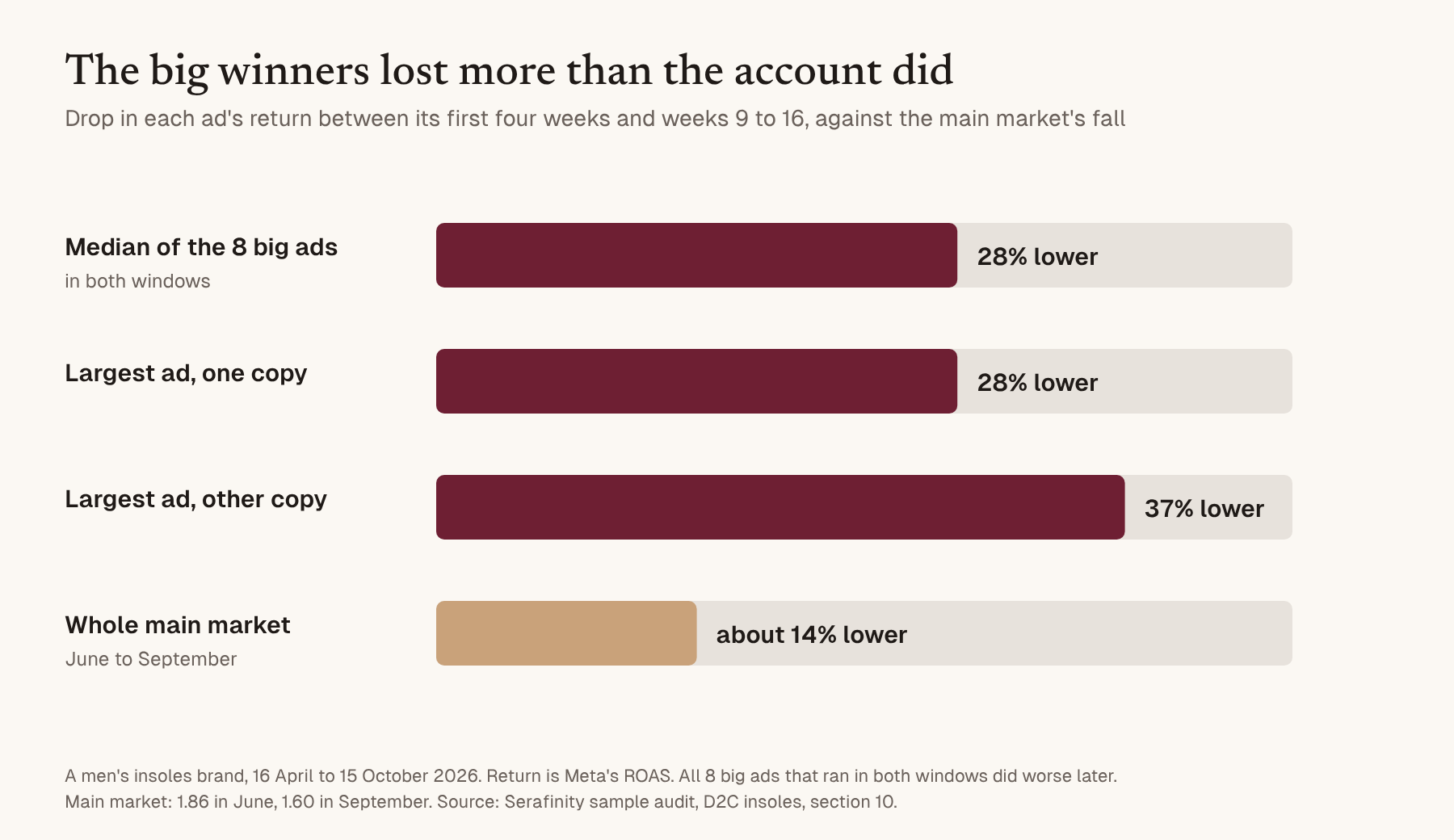
Eight of the 12 had spend in both windows. All eight made a lower return in the later window. The median ad lost 28% of its return. The two copies of the largest ad, the account's biggest video, lost 28% and 37%.
| What was measured | Drop in return |
|---|---|
| Median of the 8 big ads that ran in both windows | 28% |
| Largest ad, one copy | 28% |
| Largest ad, the other copy | 37% |
| Whole main market, June to September | About 14% |
The account was not short of ads. 5,094 ads spent money in the six months, under 3,492 creative IDs, but the ten largest took 36% of spend. When a few ads carry the budget, their wear decides the account's month.
Is it the ad or the whole account?
Check whether everything fell at once. If every ad dropped in the same week, the cause is usually the account, not the creative.
In the insoles account, part of each ad's drop was the account itself. Spend rose over the same weeks, and the main market made 1.86 in June and 1.60 in September, a fall of about 14%. Both copies of the largest ad fell further than that, so the account explains only part of their drop.
The pet skincare account shows the other case. Between March and September, monthly spend rose 5.6 times, from $5,500 to $30,900. Frequency, the average number of times each person saw an ad, went from 1.93 to 3.29, and the cost of reaching 1,000 people went from $54.83 in Q1 to $142.45 in Q3. The audit's verdict: "The extra budget was not spent finding new customers." Every ad in an account like that looks tired, because the same people are seeing all of them.
The clearest proof came from one video. Asset C returned 2.45 in one campaign, 2.39 in the testing campaign and 1.65 as a copy inside a newer campaign. The audit: "Same video, same product, same landing page." The ad didn't change. The campaign around it did.
Did someone switch my best ads off?
Sometimes the best ads didn't stop working. They stopped running. Open Activity history before you conclude anything: Meta says it "tracks all changes made to your ad campaigns, ad sets and ads", including "who made changes, what changes were made and when" (Meta, activity history).
In the pet skincare account, the best-performing campaign structure of the year returned 1.82 on $38,900, at $28.16 per purchase. It spent $366 in July and nothing after. The two most efficient ads of the year sat inside it: Asset C returned 2.11 on $8,300, with the highest click-through rate in the account, and Asset B returned 1.96 on $8,400 at $23.57 per purchase. Both stopped spending when those campaigns were paused.
The structure that replaced them took $84,400, 58% of the year's spend, and returned 1.09 at $44.25 per purchase, 57% more per purchase. Even that flatters it: the replacement counted sales from people who only saw an ad (1-day view), and the old one didn't.
Did an edit or a rebuild reset my ads?
It can. Some edits put an ad set back into the learning phase, the period when "ad sets are less stable and usually have a higher CPA" (Meta, About the learning phase). Meta lists these as significant edits (Meta, Significant edits and learning phase):
- "Any change to targeting"
- "Any change to ad creative"
- "Any change to optimization event"
- "Adding a new ad to your ad set"
- "Pausing your ad set for 7 days or longer"
- "Changing bid strategy"
Budget changes depend on size. Meta's example: going from $100 to $101 "isn't likely" to restart learning, but going from $100 to $1000 may. Learning usually ends after about 50 results in the week after the last significant edit.
The pet skincare account ran four different campaign structures in nine months. The audit: "Every handover reset the learning. Each new structure launched new campaigns, new ad sets and new ad IDs for creative that already had history." The same before-and-after video ran under three ad IDs in three campaigns, each starting from zero.
Can a tired ad come back?
Yes, and that's a reason not to kill it early. The larger copy of the insoles account's best ad, after losing ground in weeks 9 to 16, won much of it back in weeks 19 to 21 and reached 2.36 in week 20.
Meta's own advice points the same way. When it flags fatigue, its first suggestion is to create a new ad "with a new image or video that is materially different from the original creative", and it adds: "Keeping your original ad active instead of pausing or turning it off may maximize results."
The pet skincare plan relaunches its old winners "with new openings alongside the originals", rather than as fresh copies of the same ad.
How do I find which reason it is?
Work through it in this order. Each step rules out a cause before you touch the ad.
- Open Activity history for the campaign, ad set and ad. Look for a pause, a budget jump, a new ad added or an edit in the week the results dropped.
- Compare the ad with the account. If the whole account fell by the same amount in the same weeks, the ad is not the problem.
- Check the Delivery column for Creative limited or Creative fatigue, and check frequency against the same ad's first weeks.
- Count where the video is running. The same image or video in several campaigns wears out faster, because Meta counts every exposure.
- Check the page. A price change, a sold-out size or a broken checkout makes every ad look tired.
| What you see | Likely cause | Where to look |
|---|---|---|
| One ad's cost per result climbing, rest of the account steady | The ad is worn out | Delivery column, frequency |
| Every ad worse in the same week | The account changed | Activity history, budget, the store |
| Best ads show no spend | Switched off or paused | Activity history, run status |
| Results drop right after an edit | Learning phase reset | Last significant edit column |
| Frequency climbing as budget rises | Same people, more often | Reach and frequency by month |
What should I do with a tired winner?
Keep it running and put a different ad next to it. The insoles plan briefs a winner's replacement in its second month and wants it ready by the third, because by weeks 9 to 16 the largest ad's two copies had already lost 28% and 37%.
The replacement should be "materially different", in Meta's words: a new opening, a new angle, new footage. A copy of the same video under a new ad ID restarts learning without fixing the fatigue.
Then retire what is below the account average, not what looks old. In the insoles account, ads made before the review window still took 4% of spend at a 1.52 return, against 1.72 for new ones. The plan kept the best video, at 1.86 on $95,685, as the ad to beat.
Questions owners ask next
Does "Creative fatigue" in Ads Manager mean I should pause the ad?
Not on its own. Meta's advice is to add a materially different ad and keep the original running. Pause it only once the new ad is selling.
Should I turn a paused winner back on?
Usually yes, inside your current campaign, with a new opening alongside the original. Relaunching the two paused winners was the pet skincare plan's first creative action. An ad set paused for 7 days or longer goes back into learning when you unpause it.
How long does a winning Meta ad last?
There's no fixed number. In the insoles account, every big ad that ran into weeks 9 to 16 was earning less than in its first four weeks, so the plan treats a winner's third month as the deadline for its replacement.
About this data
The figures come from two Serafinity sample audits, published with the clients' written permission and anonymised at their request, with every account figure exactly as delivered. The insoles audit covers $749,655 of spend from 16 April to 15 October 2026; the ad-by-ad results are in section 10 and the replacement pace in section 19. The pet skincare audit covers $145,000 from 1 January to 30 September 2026; spend and frequency are in section 2, the campaign timeline in section 4, the paused winners in section 9 and the relaunch plan in section 17. Return here is Meta's ROAS, as Ads Manager reports it.
Meta's guidance is quoted from its Business Help Centre, checked on 10 November 2026. You can read the full insoles sample audit (PDF) and pet skincare sample audit (PDF), or see what an audit of your own account costs. Serafinity audits accounts and does not run them, so nothing here is a pitch for management.
Sources
- Serafinity, Meta Advertising Audit and 90-Day Scale Plan, D2C insoles sample, sections 10 and 19. https://serafinity.com/sample-audit-d2c-insoles.pdf
- Serafinity, Meta Advertising Audit, pet skincare sample, sections 2, 4, 9 and 17. https://serafinity.com/sample-audit-petcare.pdf
- Meta, "About creative fatigue recommendations in Meta Ads Manager," Meta Business Help Centre, checked 10 November 2026. https://www.facebook.com/business/help/1346816142327858
- Meta, "Significant edits and learning phase," Meta Business Help Centre, checked 10 November 2026. https://www.facebook.com/business/help/316478108955072
- Meta, "About the learning phase," Meta Business Help Centre, checked 10 November 2026. https://www.facebook.com/business/help/112167992830700
- Meta, "How to view activity history for your ads across Meta technologies in Meta Ads Manager," Meta Business Help Centre, checked 10 November 2026. https://www.facebook.com/business/help/289211751238030
More answers
Why did my ROAS drop when I increased my Meta ads budget?
In one audit, spend over $5,000 a day returned 1.26, then 1.02, against a 1.39 break-even. Why ROAS drops as you increase a Meta budget: diminishing returns.
Why is my Meta campaign not spending its full budget?
A £12 cost cap on £21.28 orders left one real account spending £62 of a £100 daily budget. The other reasons Meta underspends, and how to find yours.
INSIDE THE ACCOUNT S1E2: Does Meta's quality ranking tell you which ads make money?
We put Meta's three ad labels next to the sales of 79 ads in two US stores. Above-average quality ads earned less per dollar and paid more for impressions.